

 Kabukiza Theatre
Kabukiza Theatre
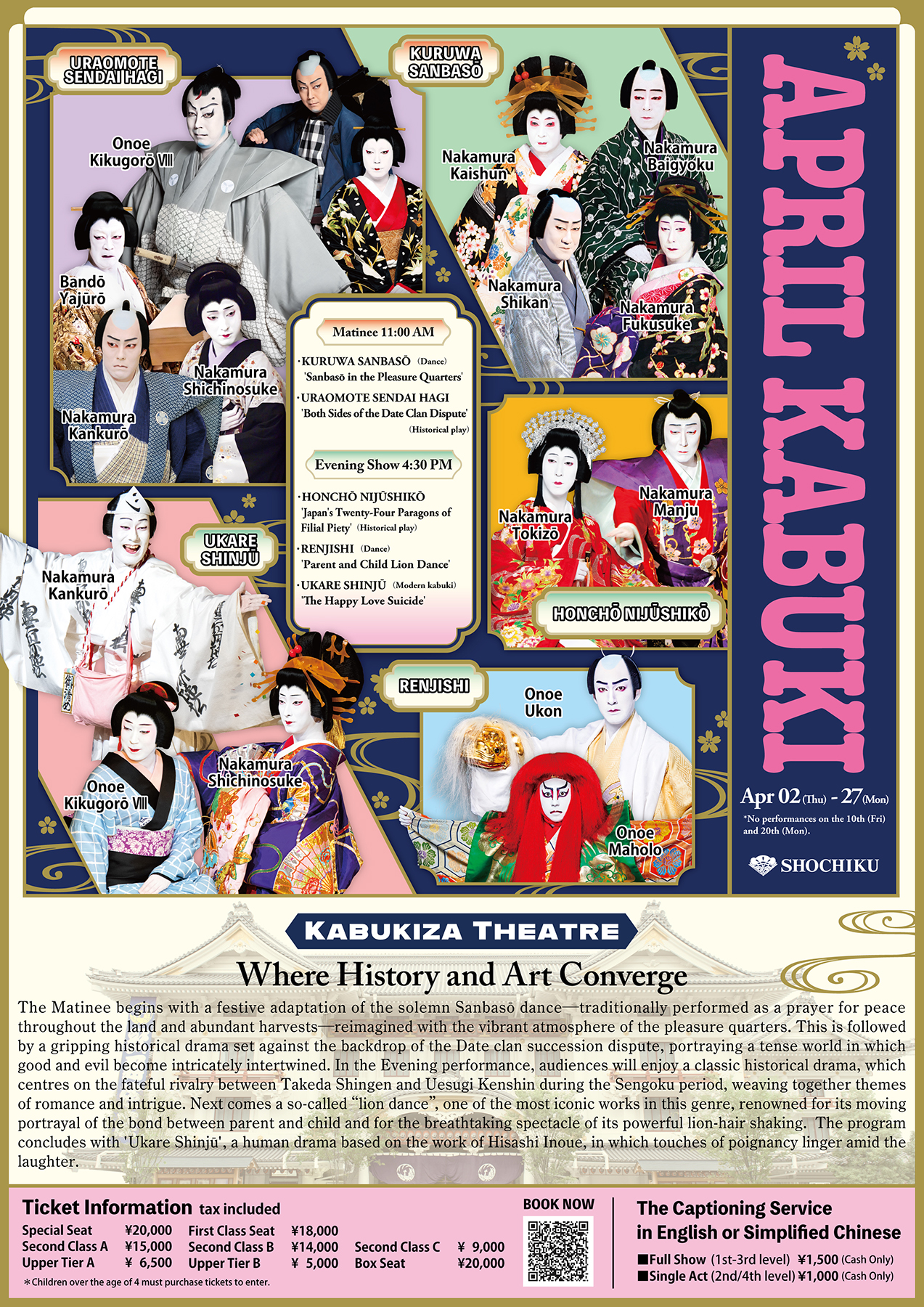
April Program at the Kabukiza Theatre
Daily: Apr 02 (Thu) - Apr 27 (Mon), 2026
Matinee:11:00 AM
Evening Show: 4:30 PM
*No performances on the 10th (Fri) and 20th (Mon).
On sale: from Mar 14 (Sat), 2026 10:00 AM(JST)
Ticket Price
Special Seat: 20,000
First Class Seat: 18,000
Second Class A: 15,000
Second Class B: 14,000
Second Class C: 9,000
Upper Tier A: 6,500
Upper Tier B: 5,000
Box Seat: 20,000
Unit: Japanese Yen (tax included)
Ticket with "Captioning Service" (either English or simplified Chinese subtitles)
Tickets that include a captioning device are available on the website. Please select "Ticket with Captioning Service" (1,500 yen will be added to the ticket price) on the ticket purchase page.
*Special Seat and Box Seat: Not available online. Click here for details.
Kabukiza Theatre (at TOKYO) Theatre Information
- Single Act Tickets
- 【🔗How to buy tickets】Tickets may still be available from the promoter, Shochiku Co., Ltd. for dates that are shown as "sold out" online. To check availability and other preferred seating areas, please call +81(0)3 6745-0888 or visit the box office.
*Captioning service (either English or simplified Chinese subtitles) available to rent. Click here for details.
*Sold program (Detailed English synopsis are found at the end of the Japanese program) available.
The Matinee begins with a festive adaptation of the solemn Sanbasō dance—traditionally performed as a prayer for peace throughout the land and abundant harvests—reimagined with the vibrant atmosphere of the pleasure quarters. This is followed by a gripping historical drama set against the backdrop of the Date clan succession dispute, portraying a tense world in which good and evil become intricately intertwined.
In the Evening performance, audiences will enjoy a classic historical drama, which centres on the fateful rivalry between Takeda Shingen and Uesugi Kenshin during the Sengoku period, weaving together themes of romance and intrigue. Next comes a so-called 'lion dance', one of the most iconic works in this genre, renowned for its moving portrayal of the bond between parent and child and for the breathtaking spectacle of its powerful lion-hair shaking. The program concludes with 'Ukare Shinjū', a human drama based on the work of Hisashi Inoue, in which touches of poignancy linger amid the laughter.
KURUWA SANBASŌ
['Sanbasō in the Pleasure Quarters']
CAST :
- A millionaire
- Nakamura Baigyoku
- A courtesan
- Nakamura Fukusuke
- A millionaire
- Nakamura Shikan
- A professional entertainer
- Nakamura Hashinosuke
- A professional entertainer
- Nakamura Fukunosuke
- A professional entertainer
- Nakamura Utanosuke
- An apprentice courtesan
- Nakamura Kangyoku
- An apprentice courtesan
- Nakamura Tamatarō
- A caretaker for a courtesan
- Nakamura Kamenojō
- A caretaker for a courtesan
- Nakamura Baika
- A sales clerk
- Nakamura Matsue
- The proprietor
- Nakamura Tōzō
- A courtesan
- Nakamura Kaishun
STORY :
'Sanbasō' is an auspicious dance based on the ritual play 'Okina' in the classical Nō Theatre which portrays an old man as a symbol of longevity, and the energetic Sanbasō as a symbol of fertility and prosperity. In kabuki there are many different versions, but this particular one is a parody set in the pleasure quarters, with a beautiful top-ranking courtesan in place of the old man, an apprentice courtesan in place of the old man's attendant Senzai, and a professional entertainer instead of the boisterous Sanbasō.
Intermission: 20 minutes
(Intermission: 35 minutes)
12:59 PM - 2:20 PM
(Intermission: 10 minutes)
2:30 PM - 2:54 PM
(Intermission: 5 minutes)
2:59 PM - 3:23 PM
Ume Momiji Nishiki no Dateori
URAOMOTE SENDAI HAGI
['Both Sides of the Date Clan Dispute']
CAST :
- Kosuke, a servant / Masaoka, a nurse / Nikki Danjō
- Onoe Kikugorō VIII
- Kurahashi Yajūrō / Hosokawa Katsumoto
- Nakamura Kankurō
- Otake, a maidservant
- Nakamura Shichinosuke
- Okinoi
- Nakamura Tokizō
- Ashikaga Yorikane
- Nakamura Kashō
- Arajishi Otokonosuke
- Nakamura Mantarō
- Watanabe Minbu
- Onoe Ukon
- Kinugawa Tanizō
- Nakamura Tanenosuke
- Yamanaka Shikanosuke
- Nakamura Utanosuke
- Senmatsu
- Nakamura Hidenosuke
- Tsuruchiyo
- Onoe Kotoya
- Mokubē, the Landlord
- Nakamura Kichinojō
- Sōeki, Dōeki’s younger brother
- Ichimura Kitsutarō
- Yokoi Kakuzaemon
- Bandō Hikosaburō
- Watanabe Gekizaemon
- Kawarasaki Gonjūrō
- Sakae Gozen
- Ichimura Manjirō
- Ōba Dōeki / Yashio
- Bandō Yajūrō
STORY :
This is a play showing both sides of the troubles that affected the Ashikaga clan. It is based on the older play 'Sendai Hagi' that describes the troubles of the Date clan in Sendai. On the outside it takes the form of a ‘jidaimono’ history play, while on the inside it depicts the case of a doctor's murder in the style of a ‘sewamono’ play. Plays of the ‘sewamono’ category depict the lives of ordinary people in the Edo period. Nikki Danjō plans to overtake the Ashikaga household and asks the doctor Ōba Dōeki to mix a poison to assassinate Tsuruchiyo, the young heir of the Ashikaga clan. Dōeki receives money as a reward, but his servant Kosuke kills him to steal the money, putting the blame on Otake whom he loves. The court lady Sakae Gozen brings Tsuruchiyo poisoned cakes, but Senmatsu, the son of Tsuruchiyo's wet-nurse Masaoka, saves Tsuruchiyo by tasting them before his young lord, as Masaoka had taught him to do. As Otake is about to be declared guilty of murdering Dōeki, Hosokawa Katsumoto's retainer Kurahashi Yajūrō produces irrefutable evidence and Kosuke is found guilty. Furthermore, Katsumoto convicts Nikki Danjō after an appeal by an old retainer who risks his life.
HONCHŌ NIJŪSHIKŌ
Jishukō
['The Ten Types of Incense' from 'Japan's Twenty-Four Paragons of Filial Piety']
CAST :
- Princess Yaegaki, Kenshin’s daughter
- Nakamura Tokizō
- Nureginu, a lady-in-waiting
- Nakamura Shichinosuke
- Hara Kobunji
- Nakamura Kashō
- Shirasuka Rokurō
- Nakamura Mantarō
- Nagao Kenshin
- Nakamura Shikan
- Minosaku, a gardener, in reality, Takeda Katsuyori
- Nakamura Manju
STORY :
Nagao Kenshin, one of Japan's most powerful feudal warlords, has borrowed a family treasure from his rival, Takeda Shingen. However, he has failed to return this treasure, which has caused a rift between the families. Kenshin's daughter, Princess Yaegaki, is mourning the death of her fiancé Katsuyori, Shingen's son, who supposedly killed himself after taking responsibility for the Shogun's assassination. However, she notices a close resemblance between her fiancé's portrait and the new gardener. The gardener is in fact Katsuyori, who has entered the household in disguise to regain possession of the stolen family treasure. Unfortunately, Kenshin has also seen through the disguise and plans to kill Katsuyori, and Princess Yaegaki decides she must take the treasure to save him. The role of Princess Yaegaki is one of the three "red princess" roles which epitomize the art of the 'onnagata' female role specialist. Such characters must combine delicate refinement with passion and an unshakable strength of will for the sake of the man she loves.
Intermission: 35 minutes
RENJISHI
['Parent and Child Lion Dance']
CAST :
- The actor Ukon, later, the spirit of the parent lion
- Onoe Ukon
- The actor Sakon, later, the spirit of the lion cub
- Onoe Maholo
- Hennen, a priest of the Pure Land Sect
- Nakamura Utanosuke
- Rennen, a priest of the Nichiren Sect
- Nakamura Fukunosuke
STORY :
This is a dance adapted from a tale featuring the legendary 'shishi', a mythical lion-like beast. It is based on the belief that a 'shishi' will push its cubs over a steep cliff as a test of their strength, only nurturing those cubs strong enough to climb up by themselves. Two priests dance the tale of the legendary 'shishi' that live at the foot of a holy Buddhist mountain. The dance portrays a parent 'shishi' forcing its cub to undergo harsh training in order to grow up strong. In the finale, the 'shishi' themselves appear and perform their dance with the wild shaking of their long manes.
Intermission: 25 minutes
UKARE SHINJŪ
['The Happy Love Suicide']
CAST :
- Eijirō
- Nakamura Kankurō
- Hahakigi of the Miuraya
- Nakamura Shichinosuke
- Osuzu
- Onoe Kikugorō VIII
- Seiroku, a carpenter
- Nakamura Hashinosuke
- Okoto, Eijirō’s younger sister
- Nakamura Tamatarō
- Gohei, the head clerk
- Ichimura Kitsutarō
- Sano Junnosuke
- Kataoka Ichizō
- Iseya Taemon
- Ichimura Manjirō
- Tasuke
- Nakamura Shikan
STORY :
This is a kabuki adaptation of the novel 'Tegusari Shinjū' (The Handcuffed Double Suicide) written by Inoue Hisashi. Eijirō, the young master of the grand Iseya store, resolves to be a novelist and is struggling to attract public attention. Today, ignoring the concerns of the head clerk Gohei, he asks to be disowned by his father, and marries Osuzu, whom he has never seen and who lives in a tenement house. The wedding ceremony descends into chaos as the go-between Tasuke does not appear, but in the end, Eijirō manages to marry her. However, the picture book he has written proves unpopular, so he ransoms the courtesan Hahakigi of the Yoshiwara pleasure quarters and asks the governmental official Sano Junnosuke to confine him in chains. His father Taemon is disgusted with him. He commits double suicide with Hahakigi to attract more public attention, but ..