

 Kabukiza Theatre
Kabukiza Theatre
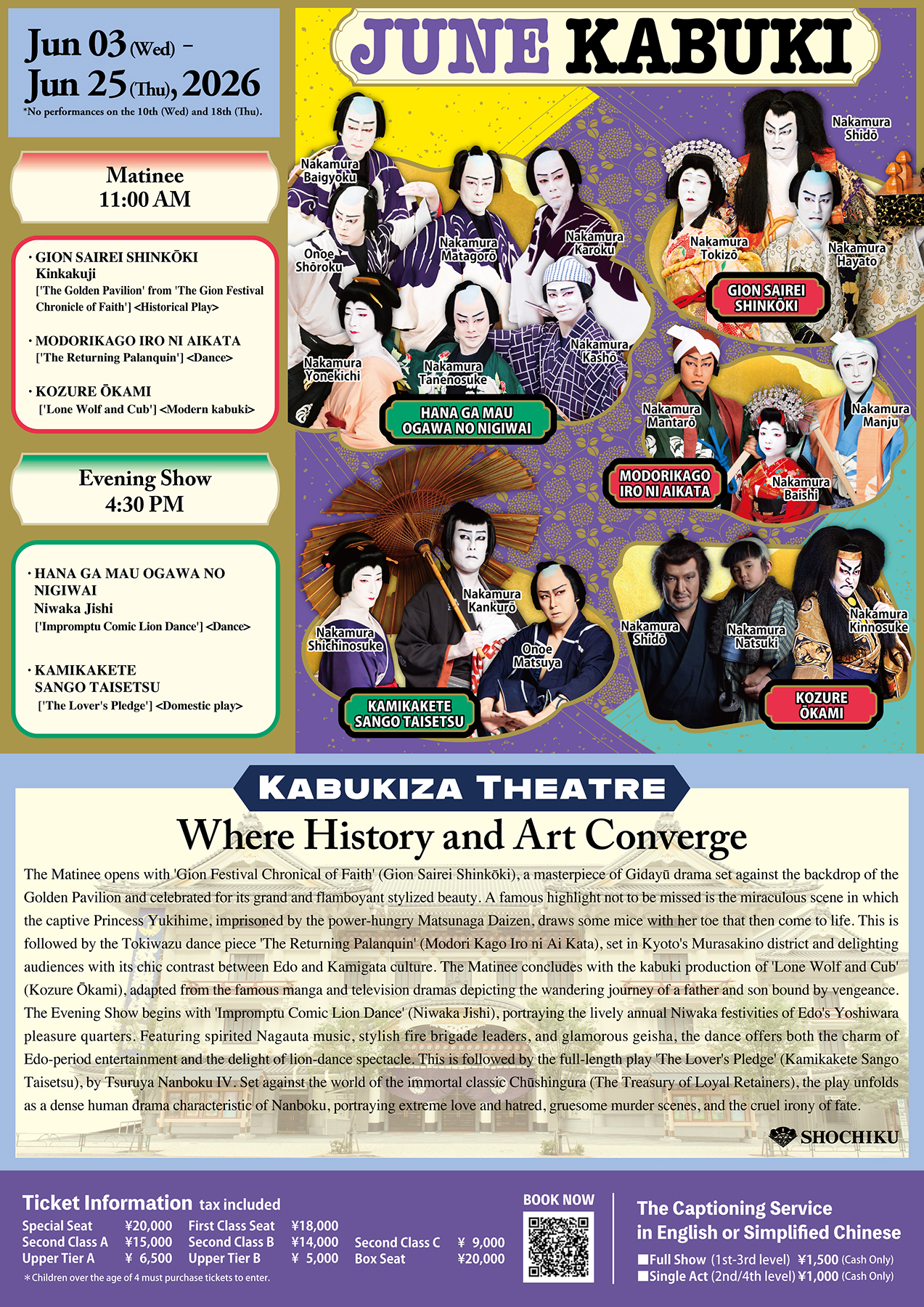
June Program at the Kabukiza Theatre
Daily: Jun 03 (Wed) - Jun 25 (Thu), 2026
Matinee:11:00 AM
Evening Show: 4:30 PM
*No performances on the 10th (Wed) and 18th (Thu).
On sale: from May 14 (Thu), 2026 10:00 AM(JST)
Ticket Price
Special Seat: 20,000
First Class Seat: 18,000
Second Class A: 15,000
Second Class B: 14,000
Second Class C: 9,000
Upper Tier A: 6,500
Upper Tier B: 5,000
Box Seat: 20,000
Unit: Japanese Yen (tax included)
Ticket with "Captioning Service" (either English or simplified Chinese subtitles)
Tickets that include a captioning device are available on the website. Please select "Ticket with Captioning Service" (1,500 yen will be added to the ticket price) on the ticket purchase page.
*Special Seat and Box Seat: Not available online. Click here for details.
Kabukiza Theatre (at TOKYO) Theatre Information
- Single Act Tickets
- 【🔗How to buy tickets】Tickets may still be available from the promoter, Shochiku Co., Ltd. for dates that are shown as "sold out" online. To check availability and other preferred seating areas, please call +81(0)3 6745-0888 or visit the box office.
*Captioning service (either English or simplified Chinese subtitles) available to rent. Click here for details.
*Sold program (Detailed English synopsis are found at the end of the Japanese program) available.
The Matinee opens with 'Gion Festival Chronicle of Faith' (Gion Sairei Shinkōki), a masterpiece of Gidayū drama set against the backdrop of the Golden Pavilion and celebrated for its grand and flamboyant stylized beauty. A famous highlight not to be missed is the miraculous scene in which the captive Princess Yukihime, imprisoned by the power-hungry Matsunaga Daizen, draws some mice with her toe that then come to life. This is followed by the Tokiwazu dance piece 'The Returning Palanquin' (Modori Kago Iro ni Ai Kata), set in Kyoto’s Murasakino district and delighting audiences with its chic contrast between Edo and Kamigata culture. The Matinee concludes with the kabuki production of 'Lone Wolf and Cub' (Kozure Ōkami), adapted from the famous manga and television dramas depicting the wandering journey of a father and son bound by vengeance.
The Evening Show begins with 'Impromptu Comic Lion Dance' (Niwaka Jishi), portraying the lively annual Niwaka festivities of Edo’s Yoshiwara pleasure quarters. Featuring spirited Nagauta music, stylish fire brigade leaders, and glamorous geisha, the dance offers both the charm of Edo-period entertainment and the delight of lion-dance spectacle. This is followed by the full-length play 'The Lovers' Pledge (Kamikakete Sango Taisetsu), by Tsuruya Nanboku IV. Set against the world of the immortal classic Chūshingura (The Treasury of Loyal Retainers), the play unfolds as a dense human drama characteristic of Nanboku, portraying extreme love and hatred, gruesome murder scenes, and the cruel irony of fate.
 Kabukiza Theatre Stage Photo
GION SAIREI SHINKŌKI
Kinkakuji
['The Golden Pavilion' from 'The Gion Festival Chronicle of Faith']
CAST :
- Yukihime, Shōgen’s daughter
- Nakamura Tokizō
- Konoshita Tōkichi, later, Mashiba Hisayoshi
- Nakamura Hayato
- Matsunaga Daizen
- Nakamura Shidō
- Kanō no suke Naonobu
- Nakamura Yonekichi
- Matsunaga Kitōta
- Nakamura Tanenosuke
- Sogō Gunpei, in reality, Satō Masakiyo
- Nakamura Kashō
- Keijuin, the shogun’s mother
- Nakamura Kinnosuke
STORY :
This is a 'jidaimono', a history play portraying the life of warriors in the 16th century. Matsunaga Daizen has defeated the shogun and has set up base at the Golden Pavilion. The beautiful Yukihime is being held prisoner there by Daizen. The brilliant strategist Hisayoshi, disguised as a disgruntled retainer named Tōkichi, pretends to enter Daizen's employ to try to sabotage his plans from within. In a famous highlight of the play, Yukihime is bound to a cherry tree, but when she draws a mouse in the tree's petals, the mouse miraculously comes to life and chews the ropes that bind her. The role of Yukihime is considered to be one of the most difficult 'princess' roles in kabuki.
Intermission: 35 minutes
MODORIKAGO IRO NI AIKATA
['The Returning Palanquin']
CAST :
- Azuma no Yoshirō, in reality, Mashiba Hisayoshi
- Nakamura Manju
- Tayori, a child apprentice to a courtesan
- Nakamura Baishi
- Naniwa no Jirōsaku, in reality, Ishikawa Goemon
- Nakamura Mantarō
STORY :
This classic is a popular dance filled with many highlights and a charming old-world atmosphere. Two palanquin bearers, Jirosaku and Yoshirō, return from the pleasure quarters carrying a 'kamuro', a child apprentice to a courtesan. They stop to rest and begin to boast to each other of their respective hometowns and pleasure quarters in Osaka and Edo. Finally, however, the men retrieve objects concealed in each other's breast pocket, revealing their true identities. Only now do they realize that they are sworn enemies: a samurai and a notorious thief!
Intermission: 25 minutes
KOZURE ŌKAMI
['Lone Wolf and Cub']
CAST :
- Ogami Ittō
- Nakamura Shidō
- Ogami Daigorō
- Nakamura Natsuki
STORY :
Set in the Edo period, 'Lone Wolf and Cub' (Kozure Ōkami) follows Ogami Ittō, the shogunate’s official executioner, who is ensnared in a plot by his sworn enemy, Yagyū Retsudō. Branded with false charges, stripped of his position, and devastated by the murder of his wife, Ittō sets out on a relentless journey of vengeance together with his young son, Daigorō. Meanwhile, Retsudō dispatches assassin after assassin in pursuit of the pair, who come to be feared throughout the land as the 'Lone Wolf and Cub'. Epic in scale, the story of Ogami Ittō’s revenge journey with Daigorō has inspired numerous film and television adaptations. In particular, the television series starring Yorozuya Kinnosuke, broadcast from 1973 to 1976, became a nationwide phenomenon. During the height of the series’ popularity, the work was adapted for the stage in 1974 as part of the celebrated 'Yorozuya Kinnosuke Special Performances' at the Kabukiza Theatre. Now returning to the Kabukiza in the month closely associated with Yorozuya acting house, this new production marks the first time that Nakamura Shidō II directs at the theatre, collaborating with film director Masanori Inoue. Audiences can look forward to a fresh revival of this enduringly popular period drama.
HANA GA MAU OGAWA NO NIGIWAI
Niwaka Jishi
['Impromptu Comic Lion Dance']
CAST :
- The head of a firefighting brigade
- Nakamura Karoku
- A geisha
- Nakamura Manju
- The head of a firefighting brigade
- Nakamura Matagorō
- The head of a firefighting brigade
- Nakamura Kinnosuke
- The head of a firefighting brigade
- Nakamura Shidō
- A geisha
- Nakamura Tokizō
- A fireman
- Nakamura Kashō
- A fireman
- Nakamura Mantarō
- A fireman
- Nakamura Tanenosuke
- A geisha
- Nakamura Yonekichi
- A fireman
- Nakamura Hayato
- A tekomai dancer
- Nakamura Baishi
- A tekomai dancer
- Nakamura Tanetarō
- A tekomai dancer
- Nakamura Hidenosuke
- A tekomai dancer
- Nakamura Haruki
- A tekomai dancer
- Nakamura Natsuki
- The head of a firefighting brigade
- Onoe Shōroku
- The head of a firefighting brigade
- Nakamura Baigyoku
STORY :
From the late Edo to the Meiji periods, an event called 'Niwaka' took place in September in the pleasure quarters where geishas and jesters performed improvised dances. This is a lively dance which might be performed at such a time, evoking the atmosphere of an Edo period festival. The highlight of the piece is the lion dance performed by two handsome young men of the neighborhood.
Intermission: 25 minutes
5:18 PM - 6:39 PM (A program) / 5:18 PM - 6:42 PM (B program)
(Intermission: 35 minutes)
7:14 PM - 8:43 PM (A program) / 7:17 PM - 8:47 PM (B program)
KAMIKAKETE SANGO TAISETSU
['The Lover’s Pledge']
CAST :
- Satsuma Gengobē
- Nakamura Kankurō (Program A)
Onoe Matsuya (Program B) - Sasanoya Sangorō
- Onoe Matsuya (Program A)
Nakamura Kankurō (Program B) - Koman, a geisha
- Nakamura Shichinosuke
- Rokushichihachiemon, Gengobē’s footman
- Nakamura Kashō
- Osaki no Inosuke
- Bandō Minosuke
- Uchibin Torazō
- Nakamura Tanenosuke
- Tominomori Suke’emon
- Nakamura Matagorō
STORY :
This is a 'sewamono', a category of plays portraying the lives of ordinary people in the Edo period (1603-1868). Sasanoya Sangorō is married to Koman, but she has become a geisha to enable him to raise the money he needs to help his lord, a man that he has never seen. In the pleasure quarters, the samurai Satsuma Gengobē falls in love with Koman and spends huge sums of money on her, despite the fact that he needs money for the sake of the 'Chūshingura' vendetta (better known as the 'Revenge of the 47 Rōnin'). Finally, Gengobē brings a large sum of money to the pleasure quarters and Sangorō and Koman decide to defraud him of it, which results in a massacre. Ironically, however, Gengobē is none other than the unknown master for whom Sangorō was trying to raise funds. This story of passion and greed takes place against the background of inexplicable fate and the strict requirements of samurai society, to which it adds ample doses of sardonic humor. A perfect play for our times!