

 Kabukiza Theatre
Kabukiza Theatre
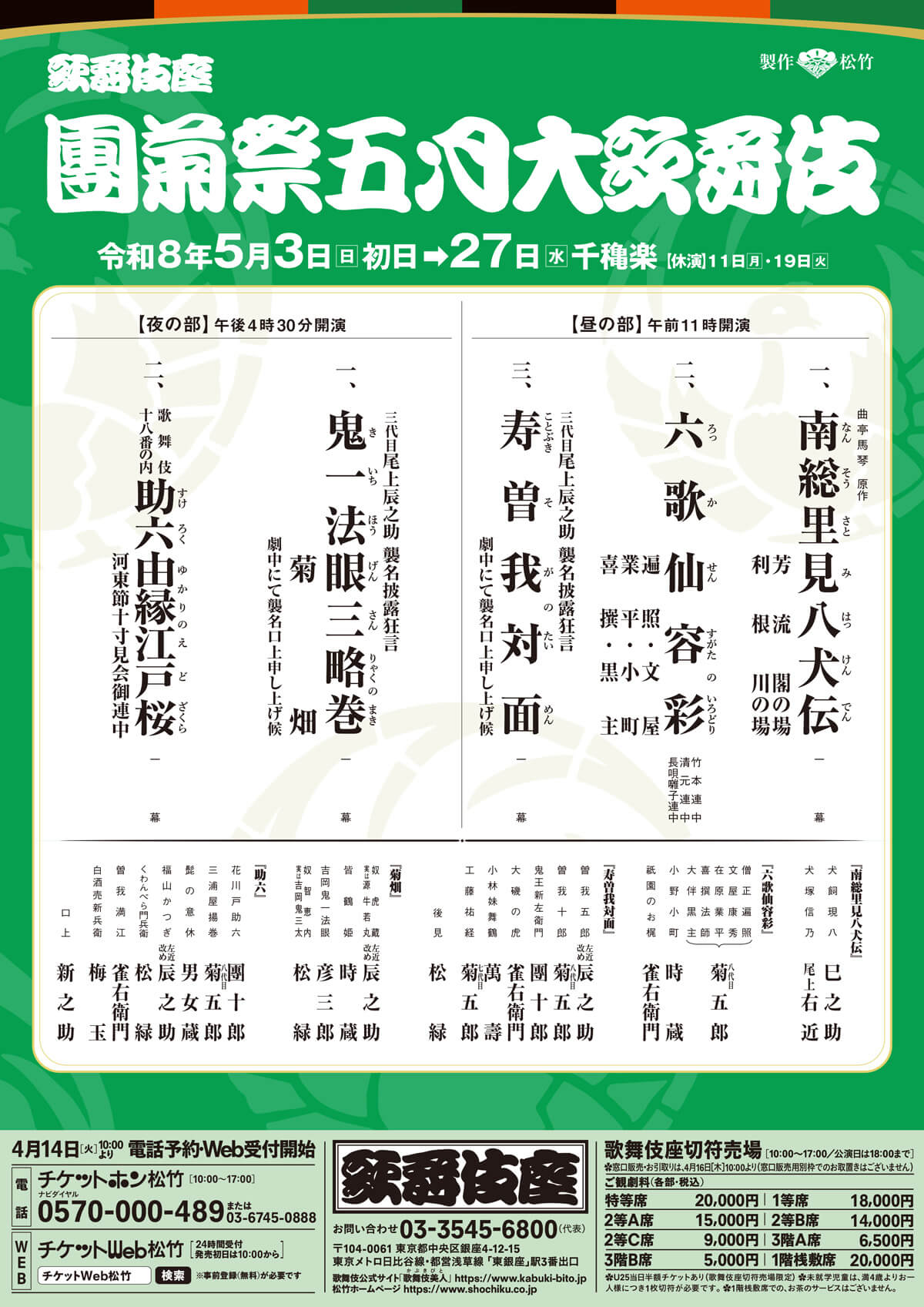
May Program at the Kabukiza Theatre
Daily: May 03 (Sun) - May 27 (Wed), 2026
Matinee:11:00 AM
Evening Show: 4:30 PM
*No performances on the 11th (Mon) and 19th (Tue).
Time Schedule
On sale: from Apr 14 (Tue), 2026 10:00 AM(JST)
Ticket Price
Special Seat: 20,000
First Class Seat: 18,000
Second Class A: 15,000
Second Class B: 14,000
Second Class C: 9,000
Upper Tier A: 6,500
Upper Tier B: 5,000
Box Seat: 20,000
Unit: Japanese Yen (tax included)
Ticket with "Captioning Service" (either English or simplified Chinese subtitles)
Tickets that include a captioning device are available on the website. Please select "Ticket with Captioning Service" (1,500 yen will be added to the ticket price) on the ticket purchase page.
*Special Seat and Box Seat: Not available online. Click here for details.
Kabukiza Theatre (at TOKYO) Theatre Information
- 【🔗How to buy tickets】Tickets may still be available from the promoter, Shochiku Co., Ltd. for dates that are shown as "sold out" online. To check availability and other preferred seating areas, please call +81(0)3 6745-0888 or visit the box office.
*Captioning service (either English or simplified Chinese subtitles) available to rent. Click here for details.
*Sold program (Detailed English synopsis are found at the end of the Japanese program) available.
The May program at the Kabukiza Theatre features the annual 'Dan-Kiku Sai' (the 'Dan-Kiku Festival'). This was first held in April and May, 1936, at the Kabukiza Theatre in honor of the actors Ichikawa Danjūrō IX and Onoe Kikugorō V who were active in the Meiji period and who lay the foundation of modern kabuki. The 'Dan-Kiku Festival' has been an annual festive event at the Kabukiza Theatre since 1977. Plays and dances associated with both acting families are included in the 'Dan-Kiku Festival' production. Please enjoy masterpieces of history play, dances and plays filled with stylish beauty of kabuki.
*Performance time is subject to change
NANSŌ SATOMI HAKKENDEN
Hōryūkaku,Tonegawa
['Hōryū Tower’ and ‘Tone River’ from 'The Tale of Eight Warriors'']
CAST :
- Inukai Genpachi
- Bandō Minosuke
- Inuzuka Shino
- Onoe Ukon
STORY :
The original novel is an immense epic by 19th century novelist Kyokutei Bakin published over many years, eventually reaching 106 volumes. The Satomi clan is being attacked and its lord offers his daughter Fusehime as a reward of bringing the head of the enemy to him. However, the one to kill and behead the enemy happens to be his loyal dog. Saying that her father must not go back on his word, Fusehime goes with the dog. Nevertheless, the Satomi clan is defeated and one of its loyal retainers goes to rescue Fusehime and shoots the dog, but unfortunately shoots Fusehime as well. The eight crystal beads of her rosary, each engraved with a Chinese character of one of the Confucian virtues, scatter through the air and go flying in all directions. Miraculously, each will be found with a newborn baby. These eight children all have the Chinese character “inu(dog)” in their names, and eventually meet and join together to restore the Satomi clan. In a famous scene, Inukai Genpachi and Inuzuka Shino fight on the roof top of Hōryū Tower not knowing each other’s identity and fall into Tone River.
Intermission: Intermission: 35 minutes
ROKKASEN SUGATA NO IRODORI
Henjō, Bunya, Narihira, Komachi, Kisen and Kuronushi
['The Six Poetic Geniuses']
CAST :
- Henjō, a high Buddhist priests
Bunya no Yasuhide
Ariwara no Narihira
Kisen, a priest
Ōtomo no Kuronushi
Onoe Kikugorō VIII- Ono no Komachi
- Nakamura Tokizō
- Okaji, a tea-house girl in Gion, Kyoto
- Nakamura Jakuemon
STORY :
A rare full-length performance of a humorous series of dances, which show the ancient poetic geniuses famous from classical Japanese literature, reinterpreted to the tastes of Edo period audiences. Ono no Komachi, the only woman of the six, was famous as a great beauty and in this dance, all the other poets are in love with her. You can enjoy the change of the atmosphere from that of the Heian Period imperial court to that of common people in the Edo Period.
Intermission: Intermission: 25 minutes
KOTOBUKI SOGA NO TAIMEN
['The Auspicious Confrontation of the Soga Brothers']
CAST :
- Soga no Gorō
- Onoe Tatsunosuke III, changing his name from Onoe Sakon III
- Soga no Jūrō
- Onoe Kikugorō VIII
- Oniō Shinzaemon
- Ichikawa Danjūrō
- Ōisono Tora
- Nakamura Jakuemon
- Maizuru, Asahina’s sister
- Nakamura Manju
- Kudō Suketsune
- Onoe Kikugorō VII
- A stage assistant
- Onoe Shōroku
STORY :
This scene is one act of a history play based on the legend of the Soga brothers vendetta. In the Edo period, plays about the vendetta carried out by the Soga brothers, Gorō and Jūrō, were performed at times of celebration. 'Soga no Taimen', in which the brothers meet their nemesis, has its roots in the earliest of these plays. This play has ceremonial aspects and features each of the important kabuki character types, including the bombastic 'aragoto' style of Gorō and the soft 'wagoto' style of Jūrō.
*Performance time is subject to change
KIICHIHŌGEN SANRYAKUNOMAKI
Kikubatake
[''The Chrysanthemum Garden' from 'Kiichi Hōgen's Book of Tactics’']
CAST :
- Torazō, a footman, in reality, Minamoto no Ushiwakamaru
- Onoe Tatsunosuke III, changing his name from Onoe Sakon III
- Princess Minazuru
- Nakamura Tokizō
- Yoshioka Kiichi Hōgen
- Bandō Hikosaburō
- Chienai, a footman, in reality, Yoshioka Kisanda
- Onoe Shōroku
STORY :
This work is a great classic of the history play genre. There is a stylized beauty in both the way of acting and in the costumes. It is full of larger-than-life characters and is performed on a stage full of dazzling color. In a garden of brilliant yellow and white chrysanthemums, we find Kiichi, an elderly strategist working for the dictator Kiyomori, and two footmen, the elegant young Torazō and the powerful Chienai. Kiichi's beautiful daughter Minazuru is deeply in love with Torazō. However, Torazō is, in fact, a young general sent there by the enemy to steal Kiichi's secret book of strategy. Chienai is his retainer. But Kiichi has realized their true identities and the reason why they are there.
Intermission: Intermission: 40 minutes
SUKEROKU YUKARI NO EDO ZAKURA
['Sukeroku, the Flower of Edo']
CAST :
- Hanakawado no Sukeroku
- Ichikawa Danjūrō
- Agemaki, a great courtesan of the Miuraya
- Onoe Kikugorō VIII
- Hige no Ikyū
- Ichikawa Omezō
- Fukuyama Katsugi
- Onoe Tatsunosuke III, changing his name from Onoe Sakon III
- Kanpera Monbē
- Onoe Shōroku
- Soga no Mankō, Sukeroku’s mother
- Nakamura Jakuemon
- Shinbē, Sukeroku’s elder brother
- Nakamura Baigyoku
- Prologist
- Ichikawa Shinnosuke
STORY :
This is a play filled with the leisurely atmosphere of old-style kabuki in its mixture of comedy and romance. 'Sukeroku' is a great showpiece for the top stars in kabuki. The dandy Sukeroku is the most famous patron of the Yoshiwara Pleasure Quarters, but his reputation as the lover of the highest-ranking courtesan Agemaki is matched by his argumentative nature and his tendency to pick fights. In fact, Sukeroku is the samurai Soga no Gorō in disguise and he uses the fights as an excuse to search for a lost heirloom sword. His quest takes place amidst of the colorful spectacle that is the Yoshiwara, where the processions of beautiful courtesans compete with the splendor of cherry blossoms in full bloom.