

 Minamiza Theatre
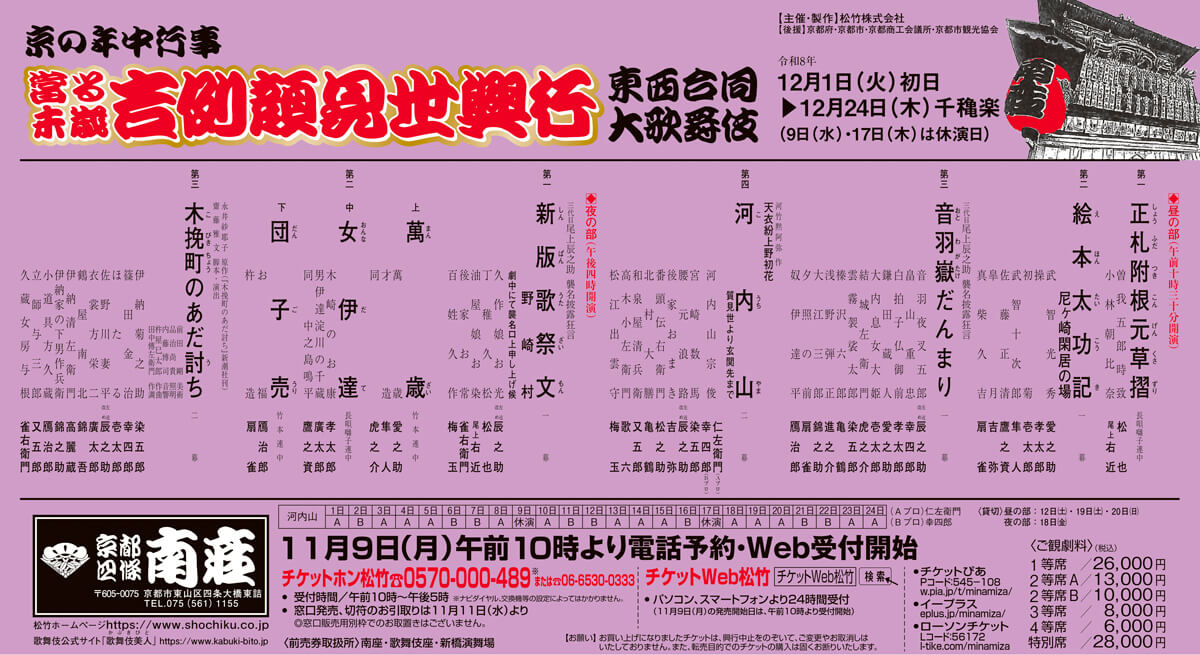
December Program at the Minamiza Theatre
Daily: Dec 01 (Tue) - Dec 24 (Thu), 2026
Matinee:10:30 AM
Evening Show: 4:00 PM
*No performances on the 9th (Wed) and 17th (Thu).
*Reserved seats are sold out on the 12th (Sat), 19th (Sat) and 20th (Sun) for Matinee, on the 18th (Fri) for Evening Show.
Time Schedule
On sale: from Nov 09 (Mon), 2026 10:00 AM(JST)
First Class Seat: 26,000 /Second Class Seat A: 13,000 / Second Class Seat B: 10,000 / Third Class Seat: 8,000 / Fourth Class Seat: 6,000
*Children over the age of 4 must purchase tickets to enter.
Unit: Japanese Yen (tax included)
*Special Seat: 28,000 (Not available online. Click here for details.)
Minamiza Theatre (at KYOTO) Theatre Information
- Book Ticket
- *English Guide available to rent.
*Free English Flyer available.
[An Annual Event in Kyoto - The Festive Kaomise Production, Grand Kabuki Starring Actors from East and West] The 'Kaomise' ('face-showing') production which has been staged annually since the Edo period (1603-1868) is an all-star line-up and a big event for December in Kyoto.
The Matinee opens with an ‘aragoto’ play featuring a colourful, traditional dance performed by a pair of actors.
This is followed by a masterpiece with Gidayū music depicting the tragedy of a samurai caught up in the turmoil of a turbulent age, and then a dance-drama in which characters search for one another in the dark, brought to life through the stylised beauty of kabuki. Finally, a famous play by Kawatake Mokuami will be performed, featuring thrilling fight scenes performed by a daring and audacious villain.
The Evening Show begins with a masterpiece of ‘sewamono’ drama, a moving tale of a simple, innocent young woman's love and her father’s devotion. This is followed by three colourful dances each with its own distinctive charm: a lively dance celebrating good fortune, a spirited performance featuring a bold and independent female outlaw, and a delightful dance portraying an affectionate married couple. The programme concludes with the Minamiza premiere of a Naoki Prize-winning work that explores the truth behind an act of revenge carried out behind a theatre. This will be the first time it is performed at the Minamiza Theatre.
*Performance time is subject to change
SHŌFUDATSUKI KONGEN KUSAZURI
['The Tug-of-War Over the Armor']
CAST :
- Soga no Gorō Tokimune
- Onoe Matsuya
- Kobayashi no Asahina
- Onoe Ukon
STORY :
A short dance in the old-fashioned style of kabuki, leisurely in pace and full of humour, featuring the larger-than-life heroism of the ‘aragoto’ style of acting. The mighty warrior Asahina attempts to restrain the hot-headed Soga no Gorō from rushing into battle by pulling on the suit of armour he is carrying.
EHON TAIKŌKI
Amagasaki Kankyo no Ba
['The Retreat in Amagasaki' from 'The Picture Book of Taikō']
CAST :
- Takechi Mitsuhide
- Kataoka Ainosuke
- Misao, Mitsuhide’s wife
- Kataoka Takatarō
- Hatsugiku
- Nakamura Kazutarō
- Takechi Jūjirō
- Nakamura Hayato
- Satō Masakiyo
- Nakamura Takanosuke
- Satsuki, Mitsuhide’s mother
- Kamimura Kichiya
- Mashiba Hisayoshi
- Nakamura Senjaku
STORY :
This is a 'jidaimono' history play portraying General Akechi Mitsuhide's life after his rebellion. Mitsuhide has killed his lord Oda Harunaga and taken over the country, but after a few days, he is in danger of losing all that he has gained to his rival general Mashiba Hisayoshi. Mitsuhide intends to attack Hisayoshi with a bamboo spear, but finds that he has fatally wounded his own mother. His mother and wife reprimand him for the disloyal act of killing his lord, but he refuses to repent. His will of steel is only broken when his son arrives to report on the battle and dies from his injuries.
OTOWA-GA-TAKE DAMMARI
['The Dammari at Mt.Otowa']
CAST :
- Otowa Yashagorō
- Onoe TatsunosukeⅢ, changing his name from Onoe SakonⅢ
- Hatakeyama Shigetada
- Matsumoto Kōshirō
- Hotoke Gozen, a shirabyōshi dancer
- Kataoka Takatarō
- Kamata no Kurando
- Kataoka Ainosuke
- Ōhhime, Ōuchi’s daughte
- Nakamura Kazutarō
- Yūki Saemon
- Nakamura Toranosuke
- Kumogiri Kesatarō
- Ichikawa Somegorō
- Hanzawa Rokurō
- Nakamura Kikaku
- Asano Danjō
- Kataoka Shinnosuke
- Ōe no Saburō
- Nakamura Kinnosuke
- Sekishō no mae
- Nakamura Senjaku
- Datehei, a footman
- Nakamura Ganjirō
STORY :
A ‘danmari’ is a wordless, stylised pantomime in which characters grope about in the darkness, usually struggling to gain possession of an important object. Traditionally performed as a scene within a longer play, it introduces the principal characters while the object passes from one person to another, creating complications that set the plot in motion. A ‘danmari’ may also be performed as an independent piece, with its own central characters and a simple plot, supported by a cast of familiar kabuki character types. ‘Otowa-ga-take Danmari’ was first performed in 1935 in memory of Onoe Kikugorō V.
Kumo ni Magou Ueno no Hatsuhana
KŌCHIYAMA
['The Tea-ceremony Priest Kōchiyama' from 'Ueno's First Cherry Blossoms Mistaken for Clouds']
CAST :
- Kōchiyama Sōshun
- Kataoka Nizaemon (Program A)
- Matsumoto Kōshirō (Program B)
- Miyazaki Kazuma
- Ichikawa Somegorō
- Namiji, a lady-in-waiting
- Onoe Tatsunosuke Ⅲ, changing his name from Onoe Sakon Ⅲ
- Kitamura Daizen
- Nakamura Kikaku
- Omaki, a widow
- Kamimura Kichiya
- Izumiya Seibē
- Nakamura Matagorō
- Takagi Kozaemon
- Nakamura Karoku
- Matsue, Lord of Izumo
- Nakamura Baigyoku
※Problem B(12/2・6・7・11・12・16・21・22)
STORY :
The 'tea-ceremony priest' Kōchiyama is a skilled extortionist and he is now working on another scheme to obtain money. He disguises himself as a high-ranking priest in order to gain the freedom of a girl who refuses to become the mistress of a powerful samurai lord and who is captured by him. During his heated discussions, in which the actor speaks the famous poetic cadences of the late 19th century playwright Kawatake Mokuami, Kōchiyama not only succeeds in his mission to rescue the girl but manages to extort a fair amount for himself.
*Performance time is subject to change
SHINPAN UTAZAIMON
Nozakimura
['Nozaki Village' from 'A New Ballad to the Gods']
CAST :
- Omitsu, Kyūsaku's daughter
- Onoe Tatsunosuke Ⅲ, changing his name from Onoe Sakon Ⅲ
- Hisamatsu, an apprentice of the Aburaya
- Onoe Matsuya
- Osome, daughter of the Aburaya pawnshop
- Onoe Ukon
- Otsune, Osome’s mother
- Nakamura Jakuemon
- Kyūsaku, a farmer
- Nakamura Baigyoku
STORY :
Osome, the daughter of a wealthy merchant, falls in love with Hisamatsu, a shop apprentice. Hisamatsu has been sent away to his home in the country and Omitsu, a simple country girl to whom he is betrothed, has happily awaited the day when she can be united with Hisamatsu as husband and wife. But on the day they marry, Osome comes to see Hisamatsu, and seeing the strength of the love between the two, Omitsu unites them by sacrificing her own happiness and becoming a nun.
MANZAI
ONNA DATE
DANGO URI
['Manzai’]
['The Female Dandy']
['The Dumpling Peddlers']
CAST :
- Manzai
- Kataoka Ainosuke
- Saizō
- Nakamura Hayato
- Saizō
- Nakamura Toranosuke
- Kizaki no Oyasu
- Kataoka Takatarō
- Yodogawa no Senzō, a chivalrous man
- Ōtani Hirotarō
- Nakanoshima Naruhei, a chivalrous man
- Nakamura Takanosuke
- Ofuku
- Nakamura Ganjirō
- Kinezō
- Nakamura Senjaku
<Manzai>
<Onna Date>
<Dango Uri>
STORY :
Manzai ['Manzai']
Manzai entertainers perform a lively dance in the streets as they pray for business prosperity.
Onna Date ['The Female Dandy’]
A strong and spirited woman comes to the city pleasure quarters and fights with a group of ruffian men.
Though her actions are rather masculine on the outside, she also displays a delicate sense of femininity as well.
The group fight at the end is a spectacular finale.
Dango Uri ['The Dumpling Peddlers']
This dance with Gidayū music portrays a couple making and selling rice dumplings on the streets. They demonstrate how they make the rice dumplings in a lively way. The making of rice dumplings is often associated with the prosperity of one's descendants, so it is considered to bring good fortune.
KOBIKICHŌ NO ADAUCHI
['The Vendetta at Kobikichō']
CAST :
- Inō Kikunosuke
- Ichikawa Somegorō
- Shinoda Kinji
- Matsumoto Kōshirō
- Hotaru
- Nakamura Kazutarō
- Sanogawa Tsumahei
- Onoe Tatsunosuke Ⅲ, changing his name from Onoe Sakon Ⅲ
- Eiji, a costumer
- Ōtani Hirotarō
- Inō Seizaemon
- Ichikawa Komazō
- Sakubē, a servant of the Inō family
- Nakamura Kinnosuke
- Kyūzō, a property man
- Nakamura Ganjirō
- Yosaburō, a choreographer
- Nakamura Matagorō
- Yone, Kyūzō’s wife
- Nakamura Jakuemon
STORY :
This is a new kabuki production adapted from an historical novel by prize-winning novelist Nagai Sayako, set in Kobikichō where the Kabukiza is situated. Inō Seizaemon, the chief retainer of a daimyō lord, suddenly slashes at his son Kikunosuke who has returned from horse riding. While Kikunosuke is bewildered by his usually calm father's sudden change, his servant Sakubē crosses swords with Seizaemon and flees. Kikunosuke heads for Edo to avenge his father's death on Sakubē. Accepting his mother's advice, Kikunosuke goes to the Moritaza Theatre at Kobikichō. Spending days looking for his father's killer, and assisted by those concerned with the theatre, one day Kikunosuke encounters the playwright Kinji and…