

 Other Theatres
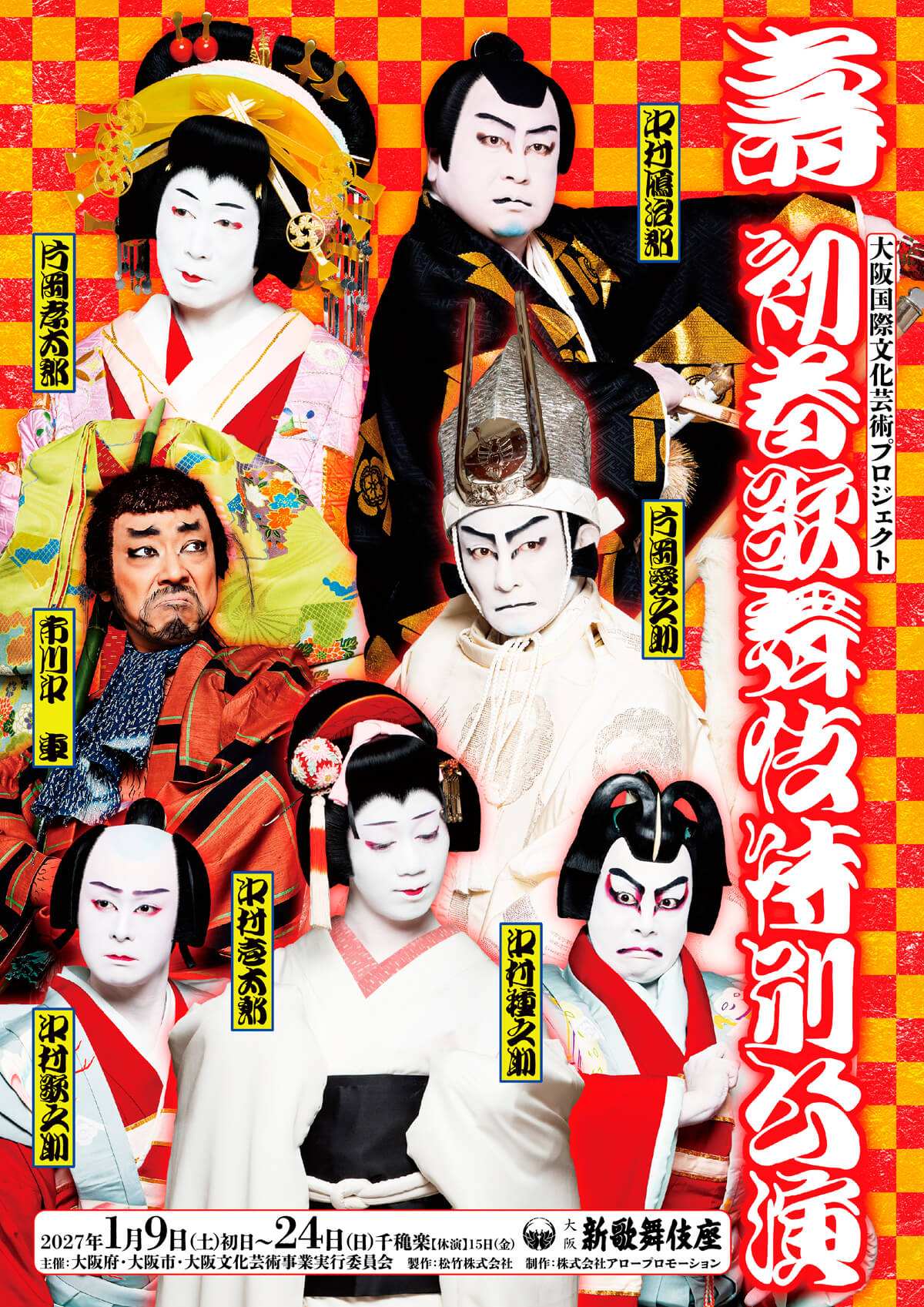
January Program at the Shinkabukiza
Daily: Jan 09 (Sat) - Jan 24 (Sun), 2027
Matinee:11:00 AM
Evening Show: 4:30 PM
*No performances on the 15th (Fri).
Time Schedule
On sale: from Nov 30 (Mon), 2026 10:00 AM(JST)
Special Seat (Level 1 & Level 2 First row) : 18,000
First Class (Level 2 - Front section from 2nd row) : 16,000
Second Class (Level 2 - Side section) : 10,000
Third Class (Level 3) : 5,000
*Children over the age of 4 must purchase tickets to enter.
Unit: Japanese Yen (tax included)
Shinkabukiza Theatre (in OSAKA)
- Book Ticket
- *English Guide available to rent in Limited availability.
*Free English Flyer available.
The Matinee offers a varied programme of captivating works: Ogurusu no Chōbē, a masterpiece of Shin Kabuki (New Kabuki) that satirizes human folly and the psychology of the crowd; The Five Thieves, a popular tale of thieves filled with splendour and style; and Love Letters from the Pleasure Quarters, a colourful and elegant piece imbued with the distinctive atmosphere of Kamigata (Kyoto and Osaka).
The Evening Show features The Auspicious Confrontation of the Soga Brothers, a festive play that epitomizes the stylized beauty of kabuki; The Tokaiya Boathouse and Daimotsu Bay scenes from the masterpiece Yoshitsune and the Thousand Cherry Trees, depicting the dramatic fate of a Heike warrior believed to have perished in battle; and The Heron Maiden, a masterpiece of classical kabuki dance presented in a production that brings out its dramatic narrative.
We hope you will enjoy this January programme celebrating the New Year.
OGURUSU NO CHŌBĒ
['Chōbē of Ogurusu Village']
CAST :
- Chōbē
- Ichikawa Chūsha
- Oine, Chōbē's sister
- Nakamura Kazutarō
- Shichinosuke
- Nakamura Tanenosuke
- Yatahachi, a packhorse driver
- Ichikawa Seiko
- Kosuzu, a shrine maiden
- Ichikawa Emisaburō
- Hōzen, a priest
- Ichikawa En'ya
- Horio Mosuke
- Nakamura Kikaku
STORY :
Chōbē is the most notorious troublemaker in Ogurusu Village, a heavy drinker who loves fighting and gambling. Hated by the villagers, he has even been disowned by his own father. One day, suspected of stealing a horse, he flies into a rage and causes such a disturbance that the villagers tie him up in a bamboo mat. However, when Horio Mosuke, a retainer of Toyotomi Hideyoshi, comes looking for the man who killed the rebel Akechi Mitsuhide with a bamboo spear, Chōbē is revealed to be the hero responsible. The villagers' attitude changes completely, and they shower him with praise as the hero of their village. Carrying the bamboo spear as proof of his achievement, Chōbē sets off for Kyoto, where Hideyoshi has established his military headquarters, to claim his reward.
Written by Okamoto Kidō, this masterpiece of Shin Kabuki (New Kabuki) uses historical events as the backdrop for a light-hearted satire of human folly and the psychology of the crowd. It was first performed in 1920 by Ichikawa En'ō I and has particularly close associations with the Omodakaya acting family.
BENTEN MUSUME MEO NO SHIRANAMI
Hamamatsuya Misesaki / Inasegawa Seizoroi
['The Hamamatsu-ya Textile Shop' and 'The Gathering along the Inase River Bank' from 'The Five Thieves']
CAST :
- Benten Kozō Kikunosuke, a thief
- Kataoka Ainosuke
- Akaboshi Jūzaburō, a thief
- Kataoka Takatarō
- Seiji, the chief of a fire brigade
- Nakamura Tanenosuke
- Sōnosuke, Kōbē's son
- Nakamura Utanosuke
- Yokurō, the head clerk
- Ichikawa Seiko
- Kōbē, owner of the Hamamatsuya
- Nakamura Kikaku
- Nangō Rikimaru, a thief
- Ichikawa En'ya
- Tadanobu Rihei, a thief
- Ichikawa Chūsha
- Nippon Daemon, chief of the gang of thieves
- Nakamura Ganjirō
STORY :
Written by the famous playwright Kawatake Mokuami, this play is a wonderful display of kabuki's stylized beauty and includes a dynamic fight scene that is performed on a particularly gorgeous stage set. In the story, a beautiful woman is suspected of shoplifting and is beaten. When it is proved that she was not stealing, her servant demands compensation. However, a samurai who happens to be present uncovers their ruse and reveals that the woman is actually a man. The former 'woman' and her accomplice are, in fact, Benten Kozō and Nangō Rikimaru, two members of the same infamous gang of thieves. Even the samurai who supposedly exposed their plot turns out to be none other than Nippon Daemon, the head of this gang. Finally, the gang is hunted down by officers and when they are surrounded, the five gang members remain defiant, delivering elaborate rhythmic speeches dressed in their finest kimono and accompanied by beautiful music.
KURUWA BUNSHŌ
Yoshidaya
['Love Letters from the Pleasure Quarters']
CAST :
- Fujiya Izaemon
- Nakamura Ganjirō
- Kizaemon of the Yoshidaya
- Nakamura Kikaku
- Okisa, Kizaemon's wife
- Ichikawa Emiya
- Yūgiri of the Ōgiya, a courtesan
- Kataoka Takatarō
STORY :
Set during the Edo Period, this is a dance drama portraying a scene in the Osaka licensed quarters at the New Year. The young lover Izaemon has been disowned by his family for loving the courtesan Yūgiri. Now dressed in nothing but a paper kimono, he visits the Yoshidaya pleasure house to meet Yūgiri. It has been a long time since they last met and they have a jealous quarrel. After that, they make up, and then at last news arrives that Izaemon's parents have relented and given them permission to marry.
KOTOBUKI SOGA NO TAIMEN
['The Auspicious Confrontation of the Soga Brothers']
CAST :
- Kudō Saemon Suketsune
- Nakamura Ganjirō
- Soga no Gorō Tokimune
- Nakamura Tanenosuke
- Soga no Jūrō Sukenari
- Nakamura Utanosuke
- Oniō Shinzaemon
- Ichikawa Seiko
- Kewaizaka no Shōshō
- Ichikawa Emisaburō
- Ōiso no Tora
- Ichikawa Emiya
- Kobayashi no Asahina
- Nakamura Kikaku
STORY :
This scene is one act of a history play based on the legend of the Soga brothers' vendetta. In the Edo period, plays about the vendetta carried out by the Soga brothers, Gorō and Jūrō, were performed at times of celebration. 'Soga no Taimen', in which the brothers meet their nemesis, has its roots in the earliest of these plays. This play has ceremonial aspects and features each of the important kabuki character types, including the bombastic 'aragoto' style of Gorō and the soft 'wagoto' style of Jūrō.
YOSHITSUNE SENBON ZAKURA
Tokaiya, Daimotsu no Ura
['The Tokaiya Boathouse and Daimotsu Bay' from 'Yoshitsune and the Thousand Cherry Trees']
CAST :
- Ginpei, a boatman, in reality Taira no Tomomori
- Kataoka Ainosuke
- Oryū, Ginpei's wife, in reality the lady Suke no Tsubone
- Nakamura Kazutarō
- Irie Tanzō
- Nakamura Utanosuke
- Sagami Gorō
- Ichikawa En'ya
- Musashibō Benkei
- Ichikawa Chūsha
- Minamoto no Yoshitsune
- Kataoka Takatarō
STORY :
Yoshitsune books passage on a boat to Kyūshū. However, the captain is actually the Heike commander Taira no Tomomori who, in this play, is living in disguise with the child emperor Antoku and his nursemaid. At first, the captain seems to be a gallant commoner, but soon he reveals himself to be Tomomori who uses this opportunity to try to take his revenge on Yoshitsune.
SAGI MUSUME
['The Heron Maiden']
CAST :
- The spirit of a heron / the girl in the story
- Nakamura Kazutarō
STORY :
On a snowy evening, a young woman stands lost in thought. As she recalls a girl who once sacrificed herself in her place, the spirit of a white heron descends. Appearing as a beautiful young woman dressed entirely in white and carrying an umbrella, the spirit expresses the bitterness of a woman betrayed in love. She then transforms into a young townswoman and performs a series of colourful dances expressing the many emotions of love. After a charming sequence of dances with the umbrella, she returns to her white costume. This mysterious figure is revealed to be the spirit of the girl who once sacrificed herself for the other. Tormented by love, she suffers the agonies of hell...
Sagi Musume (The Heron Maiden) was originally one of five dances performed in the finale of Yanagi ni Hina Shochō no Saezuri, first presented at the Ichimuraza Theatre in Edo in 1762 as part of the play Zansetsu Katsuiro Soga. The dance likens a young townswoman, caught up in passing fashions and the passions of love, to a heron on a snowy night, portraying her ultimate destruction through obsessive love.
Enjoy this production of Sagi Musume, which adds a dramatic narrative to the beauty of classical kabuki dance.