

 Kabukiza Theatre
Kabukiza Theatre
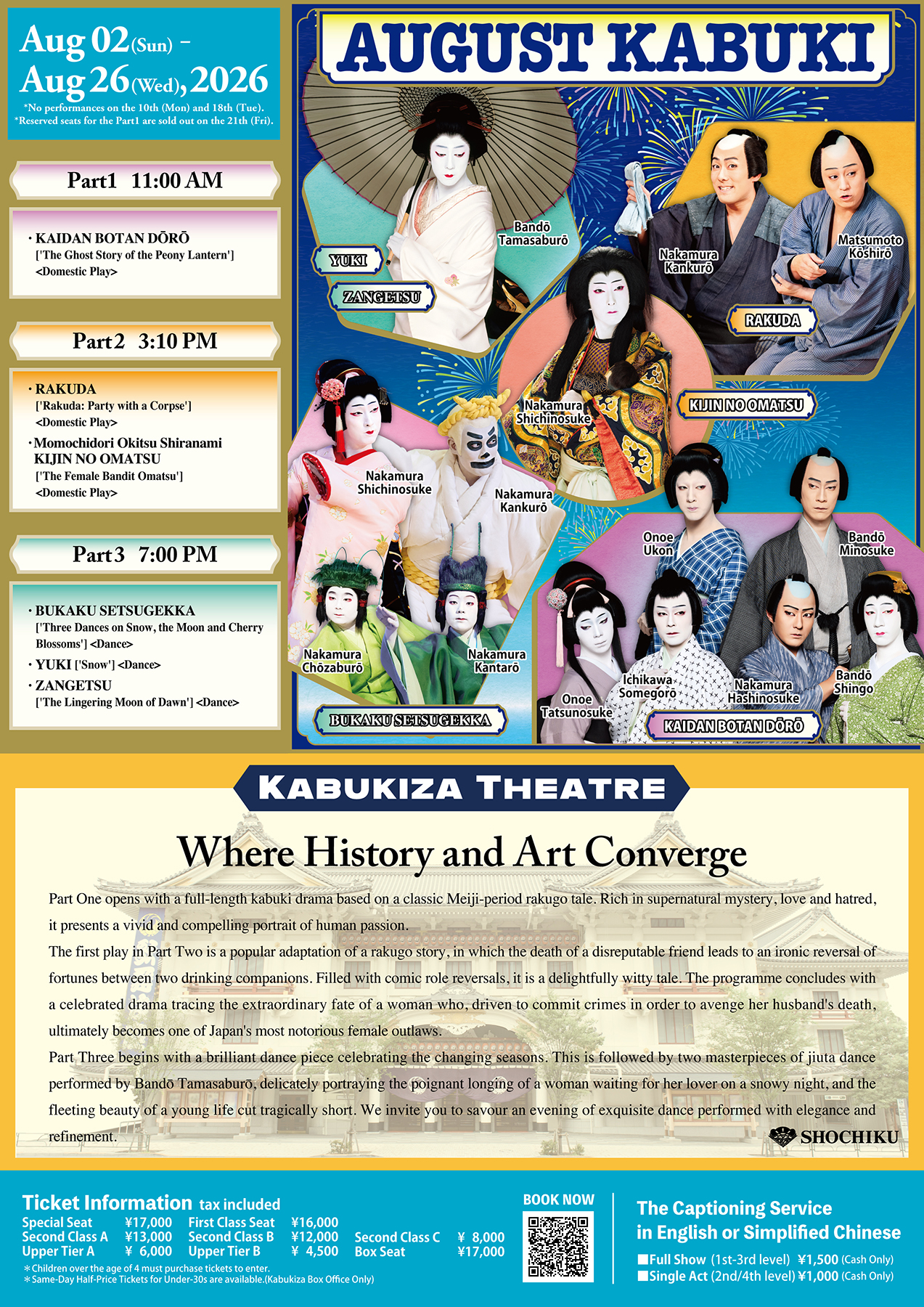
August Program at the Kabukiza Theatre
Daily: Aug 02 (Sun) - Aug 26 (Wed), 2026
Part 1: 11:00 AM
Part 2: 3:10 PM
Part 3: 7:00 PM
*No performances on the 10th (Mon) and 18th (Tue).
*Reserved seats for Part 1 are sold out on the 21st (Fri). (Single Act Seats will still be available.)
On sale: from Jul 14 (Tue), 2026 10:00 AM(JST)
Ticket Price
Special Seat: 17,000
First Class Seat: 16,000
Second Class A: 13,000
Second Class B: 12,000
Second Class C: 8,000
Upper Tier A: 6,000
Upper Tier B: 4,500
Box Seat: 17,000
Unit: Japanese Yen (tax included)
Ticket with "Captioning Service" (either English or simplified Chinese subtitles)
Tickets that include a captioning device are available on the website. Please select "Ticket with Captioning Service" (1,500 yen will be added to the ticket price) on the ticket purchase page.
*Special Seat and Box Seat: Not available online. Click here for details.
Kabukiza Theatre (at TOKYO) Theatre Information
- Single Act Tickets
- 【🔗How to buy tickets】Tickets may still be available from the promoter, Shochiku Co., Ltd. for dates that are shown as "sold out" online. To check availability and other preferred seating areas, please call +81(0)3 6745-0888 or visit the box office.
*Captioning service (either English or simplified Chinese subtitles) available to rent. Click here for details.
*Sold program (Detailed English synopsis are found at the end of the Japanese program) available.
Part 1 opens with a full-length kabuki drama based on a classic Meiji-period rakugo tale. Rich in supernatural mystery, love and hatred, it presents a vivid and compelling portrait of human passion.
The first play in Part 2 is a popular adaptation of a rakugo story, in which the death of a disreputable friend leads to an ironic reversal of fortunes between two drinking companions. Filled with comic role reversals, it is a delightfully witty tale. The programme concludes with a celebrated drama tracing the extraordinary fate of a woman who, driven to commit crimes in order to avenge her husband's death, ultimately becomes one of Japan's most notorious female outlaws.
Part 3 begins with a brilliant dance piece celebrating the changing seasons. This is followed by two masterpieces of 'jiuta' dance performed by Bandō Tamasaburō, delicately portraying the poignant longing of a woman waiting for her lover on a snowy night, and the fleeting beauty of a young life cut tragically short. We invite you to savour an evening of exquisite dance performed with elegance and refinement.
 Kabukiza Theatre Stage Photo
(Intermission: 35 minutes)
12:51 PM - 2:04 PM
KAIDAN BOTAN DŌRŌ
['The Ghost Story of the Peony Lantern']
CAST :
- Tomozō
- Bandō Minosuke
- Omine
- Onoe Ukon
- Okuni
- Bandō Shingo
- Miyanobe Genjirō
- Nakamura Hashinosuke
- Hagiwara Shinzaburō
- Ichikawa Somegorō
- Otsuyu
- Onoe Tatsunosuke
- Iijima Heizaemon
- Kawarasaki Gonjūrō
- San’yūtei Enchō / Kyūzō, a packhorse driver
- Matsumoto Kōshirō
STORY :
One of the most famous ghost stories in Japan, this play portrays the ghost of a beautiful young girl who visits the man she loves every night. Her way is lit by a lantern decorated with peonies. 'Karannn… koronnnn…', the clatter of her wooden clogs announces her appearance. The story, originally from China, became a Japanese classic when it was transformed into a long rakugo story by San'yūtei Enchō (1839 - 1900).
Otsuyu the daughter of a samurai family falls in love with a young samurai named Shinzaburō, but falls sick and dies longing for him. Her ghost begins to visit him nightly, the way led by the ghost of her nursemaid carrying a lantern decorated with peonies. Shinzaburō welcomes these meetings, not realizing she is dead. However, a priest sees the signs of death and protects Shinzaburō with holy amulets and a powerful Buddhist statue. Trying to take the amulets away, the ghosts bribe Shinzaburō's greedy servant Tomozō and his wife Omine. Once the amulets are taken away, Shinzaburō is killed by the ghosts. Tomozō and Omine run away with the money, but the money doesn't bring them happiness. Tomozō gets involved with Okuni, a waitress at the restaurant Sasaya, and visits it frequently to see her. Omine learns this and questions him closely. The lantern decorated with peonies flies to them from nowhere as they quarrel. This version of the story is not just a tale of ghosts, but shows human treachery, greed and the revolving ironies of fate.
Nemuruga Rakuda Monogatari
RAKUDA
['Rakuda: Party with a Corpse']
CAST :
- Kyūroku, a waste paper collector
- Nakamura Kankurō
- Chōname no Hanji
- Matsumoto Kōshirō
- Oiku, Sahē’s wife
- Sasano Takashi
- Rakuda no Umatarō
- Kataoka Ichizō
- Sahē, the landlord
- Bandō Yajūrō
STORY :
This is a popular dramatization of a rakugo comic story. A petty gang member called Rakuda has died after eating blowfish. Hanji, one of his evil companions, finds him and hopes to hold a wake, but has no money. Every neighbor is overjoyed to hear that such a nuisance is dead, but when Hanji tries to get them to contribute, they refuse to contribute a single penny to his burial. Hanji threatens Kyūroku, the waste paper collector, and demands that he go to the landlord's house carrying Rakuda's corpse to obtain condolence money. The plan works and they succeed in having the saké delivered. They start drinking together, but as they drink, the hapless Kyūroku becomes surprisingly aggressive.
Intermission: 25 minutes
Momochidori Okitsu Shiranami
KIJIN NO OMATSU
['Plovers over White Waves Off Shore' commonly known as 'The Female Bandit Omatsu']
CAST :
- The female bandit Omatsu
- Nakamura Shichinosuke
- Natsume Shirojirō
- Onoe Ukon
- Fujinami, Mondo’s sister
- Nakamura Yonekichi
- Shibahei, Shirotarō’s servant
- Nakamura Toranosuke
- Kosuke, a robber, in reality Kinezumi
- Nakamura Utanosuke
- Shinohara Ichigaku
- Nakamura Fukunosuke
- Natsume Shirotarō
- Nakamura Kashō
- Makimura Mondo
- Nakamura Senjaku
STORY :
Natsume Shirojirō’s devoted wife, Omatsu, hides a secret: she is the leader of a band of female outlaws determined to recover the treasured sword that was stolen from her husband’s lord—a loss that brought disgrace upon Shirojirō and reduced him to a masterless warrior. One day, Omatsu kills a travelling swordsman, only to discover to her horror that he was Shirojirō’s own brother. As tragedy deepens, Shirojirō, having been deceived into accepting a counterfeit of the treasured sword, prepares to take his own life in ritual suicide. Preventing his death, Omatsu sets out into the pitch-dark night in search of the genuine blade. Her quest leads to a climactic battle at a dilapidated temple, where she fights desperately to reclaim the treasured sword—but...
BUKAKU SETSUGEKKA
['Three Dances on Snow, the Moon and Cherry Blossoms']
CAST :
- <First Scene>
The spirit of the cherry blossom
Nakamura Shichinosuke- <The Next Scene>
A matsumushi (pine cricket)
Nakamura Kantarō- A matsumushi (pine cricket)
- Nakamura Chōzaburō
- <The Last Scene>
Snowman
Nakamura Kankurō
STORY :
It is common in Japan to celebrate beauty through themed sets, and this dance presents three seasonal images. The first dance evokes the cherry blossoms of spring, the second describes the songs of 'matsumushi' insects under the moon in autumn, and the third dance evokes a snowman or 'yuki daruma' to complete the set with a scene of winter.
Intermission: 30 minutes
YUKI
['Snow']
CAST :
-
Bandō Tamasaburō
STORY :
This dance is accompanied by a masterpiece of 'jiuta' music (songs from the Kyoto/Osaka region) that was composed in the 1780s. It is about a former geisha and her sad yet beautiful feelings. A geisha who is now a nun recalls the days of her past when she waited for her lover's visit alone on a snowy night.
Intermission: 20 minutes
ZANGETSU
['The Lingering Moon of Dawn']
CAST :
-
Bandō Tamasaburō
STORY :
This work is said to have been composed in memory of the premature death of the daughter of Matsuya, a pupil of Minezaki Kōtō, and the title of the piece is said to have been inspired by her posthumous Buddhist name. Enjoy Tamasaburō's exquisite 'jiuta-mai' dance, which quietly portrays the imagery of a moon that appears and disappears, and the fleeting fragility of the young woman's life.