

 Kabukiza Theatre
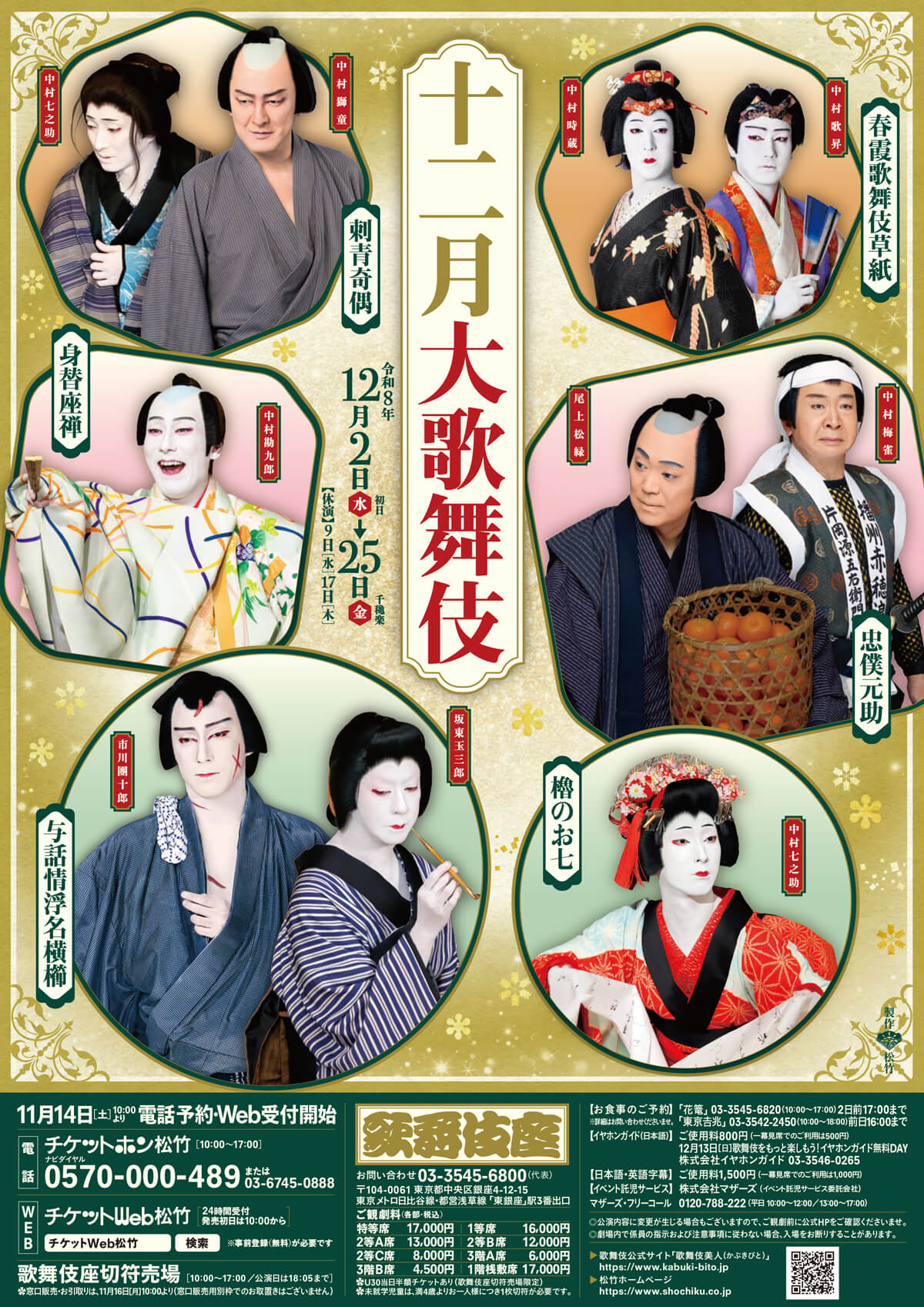
December Program at the Kabukiza Theatre
Daily: Dec 02 (Wed) - Dec 25 (Fri), 2026
Part 1: 11:00 AM
Part 2: 2:30 PM
Part 3: 6:00 PM
*No performances on the 9th (Wed) and 17th (Thu).
Time Schedule
On sale: from Nov 14 (Sat), 2026 10:00 AM(JST)
Ticket Price
Special Seat: 17,000
First Class Seat: 16,000
Second Class A: 13,000
Second Class B: 12,000
Second Class C: 8,000
Upper Tier A: 6,000
Upper Tier B: 4,500
Box Seat: 17,000
Unit: Japanese Yen (tax included)
Ticket with "Captioning Service" (either English or simplified Chinese subtitles)
Tickets that include a captioning device are available on the website. Please select "Ticket with Captioning Service" (1,500 yen will be added to the ticket price) on the ticket purchase page.
*Special Seat and Box Seat: Not available online. Click here for details.
Kabukiza Theatre (at TOKYO) Theatre Information
- 【🔗How to buy tickets】Tickets may still be available from the promoter, Shochiku Co., Ltd. for dates that are shown as "sold out" online. To check availability and other preferred seating areas, please call +81(0)3 6745-0888 or visit the box office.
*Captioning service (either English or simplified Chinese subtitles) available to rent. Click here for details.
*Sold program (Detailed English synopsis are found at the end of the Japanese program) available.
In Part 1, enjoy a fantastical dance featuring Okuni, regarded as the founder of kabuki, followed by a masterpiece of Shin Kabuki (New Kabuki) portraying the tragic plight of a man who cannot give up gambling despite having a devoted wife.
Part 2 features a moving human drama set on the eve of the historic revenge carried out by the forty-seven masterless samurai, followed by a humorous dance drama depicting the exchanges between an unfaithful husband and his suspicious wife.
In Part 3, enjoy a masterpiece of domestic drama portraying the extraordinary twists of fate that befall a man and a woman, with dialogue delivered in the pleasing rhythms of alternating seven- and five-syllable phrases, followed by a dance expressing the sorrow of a young woman consumed by love, through movements inspired by those of a Bunraku puppet.
*Performance time is subject to change
HARU GASUMI KABUKI ZŌSHI
['A Kabuki Scroll']
CAST :
- Izumo no Okuni
- Nakamura Tokizō
- Nagoya Sanza
- Nakamura Kashō
STORY :
Kabuki is said to have begun in the early 17th century with the colorful dances of the shrine maiden Okuni and the short sketches she performed with her lover, the gallant samurai Nagoya Sanza. This modern dance recreates the romantic atmosphere of the earliest days of kabuki.
IREZUMI CHŌHAN
['Tattooed Hantarō']
CAST :
- Hantarō, a gambler
- Nakamura Shidō
- Masagorō, “The Shark”, a gang boss
- Ichikawa Udanji
- Onaka, a prostitute
- Nakamura Shichinosuke
STORY :
First performed in 1932, this is a so-called 'New Kabuki' ('Shin Kabuki') play by Hasegawa Shin. Hantarō was born in Fukagawa in Edo (the old name for Tokyo), but he now lives in Gyōtoku in Shimōsa Province after having to leave Edo on account of a quarrel. The argument was caused by his weakness for gambling. Hantarō rescues a waitress called Onaka who was trying to drown herself. Onaka is touched by his purity and they marry. Hantarō still loves gambling and they continue to lead a poor life. Meanwhile, Onaka discovers that she has a severe illness and, while she still lives, she inscribes a tattoo of a pair of dice on Hantarō's right arm, reminding him always of her wish that he give up gambling. However, desperate for the money to pay for Onaka's medicine, Hantarō goes again to a gambling house where he is caught cheating and severely beaten. Masagorō, who operates the gambling house, hears that Hantarō would like to do something good for his dying wife so he bets all his money on a gambling game with Hantarō. Hantarō wins the game. He receives the money from Masagorō and hurries home to his wife.
*Performance time is subject to change
CHŪBOKU MOTOSUKE
['The loyal servant Motosuke']
CAST :
- Motosuke, Gengoemon’s servant
- Onoe Shōroku
- Kataoka Gengoemon
- Nakamura Baijaku
STORY :
On 13 December 1702, Kataoka Gengoemon, one of the loyal retainers of Akō preparing to attack Kira's mansion the following day, attempts to dismiss Motosuke, a servant who has served him for many years. But the devoted Motosuke refuses to leave his master's service... This is the story of Motosuke, a man who, though not a samurai himself, plays a vital role behind the scenes in the vendetta carried out by the loyal retainers of Akō, displaying unwavering devotion to his master. Based on one of the Akō Gishi Gaiden (Side Stories of the Loyal Retainers of Akō) performed by Kanda Shōri, a kōdan storyteller designated a Living National Treasure, this new kabuki production reunites the creative team behind previous adaptations of kōdan stories. We hope you will enjoy this moving portrayal of the deep bond between a master and his faithful servant.
MIGAWARI ZAZEN
['The Zen Substitute']
CAST :
- Yamakage Ukyō
- Nakamura Kankurō
- Tarōkaja, Ukyō’s servant
- Onoe Shōroku
- Tamanoi, Ukyō’s servant
- Ichikawa Danjūrō
STORY :
This is a dance drama adapted from a classical kyōgen comedy. Lord Yamakage Ukyō wants nothing more than to visit his lover Hanago, but he has one important problem: his homely and overbearing wife will not leave his side. He thinks of several excuses to leave the house, but when these are rejected, he finally insists that he will practice Zen meditation all night. However, he cheats by making his servant Tarōkaja take his place so that he can go off secretly to see Hanago. When he returns, giddy from a night of pleasure and tells his story to Tarōkaja in dance form, he is unaware that his wife has discovered his deception.
*Performance time is subject to change
YOWA NASAKE UKINA NO YOKOGUSHI
['Scar faced Yosaburō']
CAST :
- Yosaburō
- Ichikawa Danjūrō
- Kōmori Yasu
- Onoe Shōroku
- Kingorō, chief of a fire brigade
- Ichikawa Udanji
- Izumiya Tazaemon
- Nakamura Kankurō
- Otomi
- Bandō Tamasaburō
STORY :
At the seaside, Yosaburō, the spoilt son of a wealthy family, meets Otomi, the mistress of a gang boss, and falls in love with her at first sight. The affair is soon found out by the gang boss and Yosaburō gets beaten up, suffering scars all over his body. Thinking that Yosaburō died, Otomi throws herself into the sea. Three years later, Yosaburō, who has become a petty thief, and his mentor Yasu, nicknamed 'the Bat', go to blackmail the mistress of a wealthy merchant, only to discover that it is Otomi, who also survived. In one of the most famous scenes in kabuki, Yosaburō pours out his resentment against Otomi and bemoans the fate that has destroyed his life. Then Otomi learns the secret about her situation...
Date Musume Koi No Higanoko
YAGURA NO OSHICHI
['Yaoya Oshichi and the Fire Watchtower']
CAST :
- Oshichi, a daughter of a greengrocer
- Nakamura Shichinosuke
STORY :
The scene is set in Edo (present-day Tokyo), blanketed in snow. Oshichi, the daughter of a greengrocer, rushes up a fire watchtower, determined to save her lover Kichisaburō, who is wanted by the authorities, whatever the consequences... Based on a historical incident arising from a young woman's passionate love, this dance portrays her unwavering devotion, sorrow and burning emotions through ningyō-buri, a style of performance in which the dancer imitates the movements of a Bunraku puppet. We hope you will enjoy this dramatic and fantastical dance.