

 Kabukiza Theatre
Kabukiza Theatre
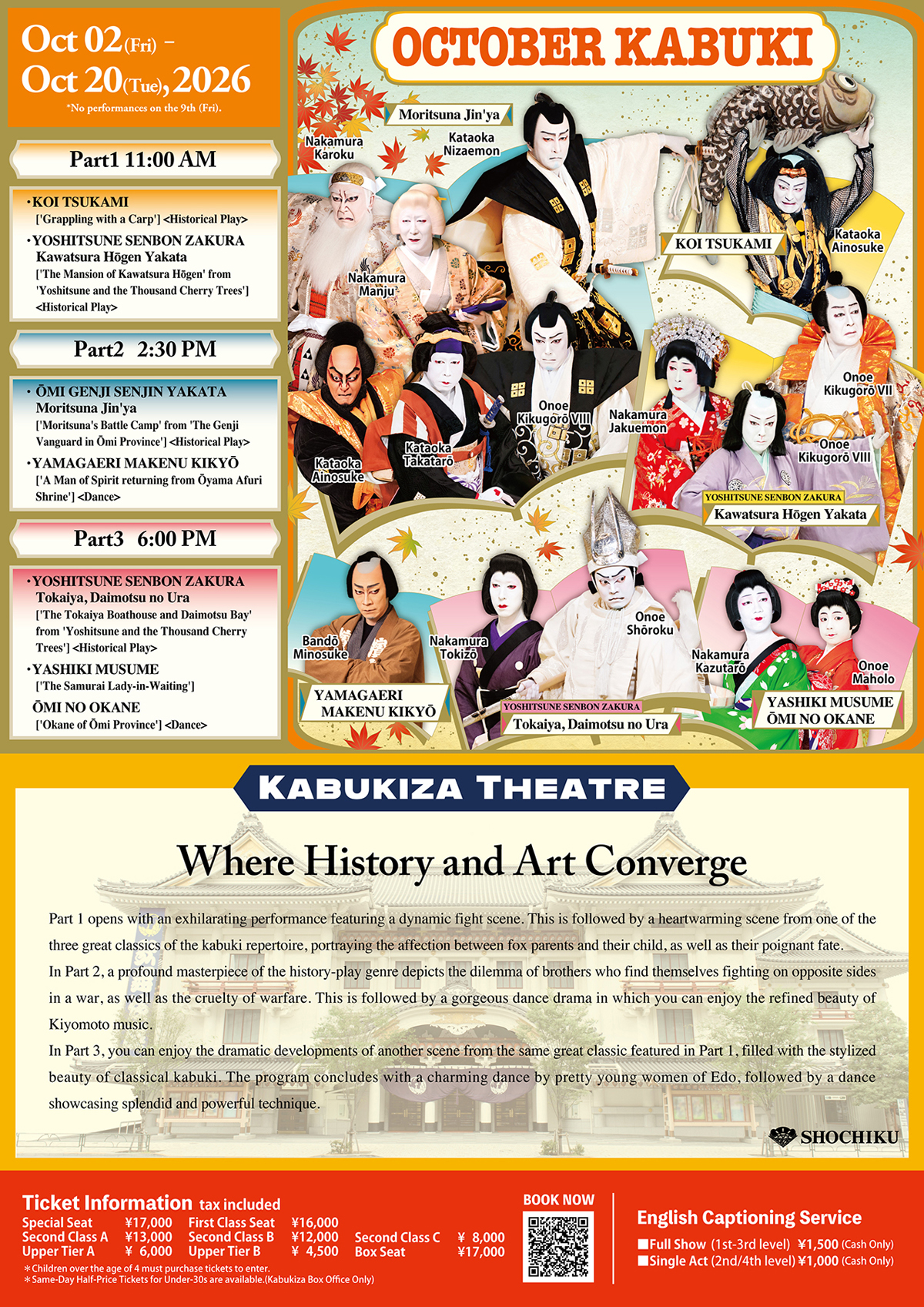
October Program at the Kabukiza Theatre
Daily: Oct 02 (Fri) - Oct 20 (Tue), 2026
Part 1: 11:00 AM
Part 2: 2:30 PM
Part 3: 6:00 PM
*No performances on the 9th (Fri).
On sale: from Sep 14 (Mon), 2026 10:00 AM(JST)
Ticket Price
Special Seat: 17,000
First Class Seat: 16,000
Second Class A: 13,000
Second Class B: 12,000
Second Class C: 8,000
Upper Tier A: 6,000
Upper Tier B: 4,500
Box Seat: 17,000
Unit: Japanese Yen (tax included)
Ticket with "Captioning Service" (either English or simplified Chinese subtitles)
Tickets that include a captioning device are available on the website. Please select "Ticket with Captioning Service" (1,500 yen will be added to the ticket price) on the ticket purchase page.
*Special Seat and Box Seat: Not available online. Click here for details.
Kabukiza Theatre (at TOKYO) Theatre Information
- Single Act Tickets
- 【🔗How to buy tickets】Tickets may still be available from the promoter, Shochiku Co., Ltd. for dates that are shown as "sold out" online. To check availability and other preferred seating areas, please call +81(0)3 6745-0888 or visit the box office.
*Captioning service (either English or simplified Chinese subtitles) available to rent. Click here for details.
*Sold program (Detailed English synopsis are found at the end of the Japanese program) available.
Part 1 opens with an exhilarating performance featuring a dynamic fight scene. This is followed by a heartwarming scene from one of the three great classics of the kabuki repertoire, portraying the affection between fox parents and their child, as well as their poignant fate.
In Part 2, a profound masterpiece of the history-play genre depicts the dilemma of brothers who find themselves fighting on opposite sides in a war, as well as the cruelty of warfare. This is followed by a gorgeous dance drama in which you can enjoy the refined beauty of Kiyomoto music.
In Part 3, you can enjoy the dramatic developments of another scene from the same great classic featured in Part 1, filled with the stylized beauty of classical kabuki. The program concludes with a charming dance by pretty young women of Edo, followed by a dance showcasing splendid and powerful technique.
 Kabukiza Theatre Stage Photo
KOI TSUKAMI
['Grappling with a Carp']
CAST :
- Takimado Shiganosuke / Takimado Shiganosuke, in reality, the Spirit of a Carp
- Kataoka Ainosuke
- Shinomura Jirō Kinmitsu
- Bandō Minosuke
- Princess Kozakura
- Nakamura Kazutarō
- Kuretake
- Ichikawa Monnosuke
STORY :
The play 'Koi Tsukami' includes a spectacular fight scene performed in real water between the hero and the spirit of a carp.
Princess Kozakura, the daughter of the Tsuri family, yearns for the handsome Takimado Shiganosuke. One day, as she tries to distract herself by catching fireflies, Shiganosuke appears before her. They return to the mansion and go into an inner room. Soon, however, a second Shiganosuke arrives, carrying Ryūjinmaru, the Tsuri family’s heirloom sword. Shinomura Jirō, the chief retainer of the Tsuri family is bewildered by the appearance of two identical Shiganosukes, but recognizes the sword carried by the newcomer as the genuine heirloom. Katada no Gyōbu, a retainer of the imperial chief advisor, arrives and summons Princess Kozakura. However, the second Shiganosuke exposes Gyōbu’s evil plot and strikes him down with Ryūjinmaru. At that moment, the mysterious power of the sword causes the shadows of Princess Kozakura and a carp to appear on the paper sliding door of the inner room. The truth is revealed: the first Shiganosuke is actually the incarnation of the spirit of a carp from Lake Biwa, which bears a grudge against the ancestors of the Tsuri family. The carp swallows Princess Kozakura in a single mouthful. The scene then shifts to Lake Biwa, where the real Shiganosuke appears and fights with the giant carp, eventually defeating it and saving Princess Kozakura's life.
Intermission: 35 minutes
YOSHITSUNE SENBON ZAKURA
Kawatsura Hōgen Yakata
['The Mansion of Kawatsura Hōgen' from 'Yoshitsune and the Thousand Cherry Trees']
CAST :
- Satō Tadanobu / Tadanobu, in reality, the fox Genkurō
- Onoe Kikugorō VIII
- Shizuka Gozen
- Nakamura Jakuemon
- Asuka, Hōgen’s wife
- Kamimura Kichiya
- Kawatsura Hōgen
- Kawarasaki Gonjūrō
- Minamoto no Yoshitsune
- Onoe Kikugorō VII
STORY :
This scene from this classic history play is full of quick-changes of role and costume. A magical fox takes on the guise of the warrior named Tadanobu in order to get close to a precious drum made from the skins of his fox parents. However, his mysterious activities throw suspicion on the real Tadanobu, and finally the fox reveals his true identity. In the end, he flies away joyously after he receives the drum.
ŌMI GENJI SENJIN YAKATA
Moritsuna Jin'ya
['Moritsuna's Battle Camp' from 'The Genji Vanguard in Ōmi Province']
CAST :
- Sasaki Moritsuna
- Kataoka Nizaemon (Program A)
- Onoe Kikugorō VIII (Program B)
- Kagaribi, Takatsuna’s wife
- Kataoka Takatarō
- Wada Byōe Hidemori
- Kataoka Ainosuke
- Shigaraki Tarō
- Bandō Minosuke
- Ibuki no Tōta
- Nakamura Tanenosuke
- Koshirō, Takatsuna’s son
- Nakamura Baishi
- Kosaburō, Moritsuna’s son
- Nakamura Hidenosuke
- Furugōri Shinzaemon
- Arashi Kitsusaburō
- Takenoshita no Magohachi
- Nakamura Mantarō
- Hayase, Moritsuna’s wife
- Nakamura Tokizō
- Mimyō, Moritsuna’s mother
- Nakamura Manju
- Hōjō Tokimasa
- Nakamura Karoku
※Program B (10/4・5・8・10・13・14・17・18・19)
STORY :
This is a 'jidaimono' history play set in the Kamakura Period (1185-1333). War has broken out between Minamoto no Yoriie in Kyoto and Hōjō Tokimasa in Kamakura. The Sasaki brothers Moritsuna and Takatsuna fight on opposite sides. Takatsuna's son Koshirō is captured and held prisoner by Moritsuna. When a general from Takatsuna's side comes to ask for the boy's return, Moritsuna worries that his brother's love for his son will cause him shame. Soon, the news of Takatsuna's death is reported and Tokimasa arrives with Takatsuna's head. Moritsuna is ordered to verify that the head is really that of his brother. Before Moritsuna has completely lifted the lid of the head box, Koshirō runs out and commits ritual suicide, saying he will follow his father to the grave. However, looking at the head, Moritsuna sees that it is not Takatsuna. This is all a ruse to fool the enemy. Impressed by Koshirō's brave sacrifice, Moritsuna declares falsely in Tokimasa's presence that the head is indeed that of Takatsuna.
Intermission: 25 minutes
YAMAGAERI MAKENU KIKYŌ
['A Man of Spirit returning from Ōyama Afuri Shrine']
CAST :
- Daikichi returning from Ōyama Afuri Shrine
- Bandō Minosuke
STORY :
The fireman Daikichi appears on a highway with a fine view of Mt. Ōyama as he makes his way back to Edo (present-day Tokyo) after a pilgrimage to Ōyama Afuri Shrine. Like many others, Daikichi has used his pilgrimage as an excuse to indulge in some disreputable pleasures, and he comically recounts his escapades in dance. This dance, set to Kiyomoto music, was first performed by Bandō Mitsugorō III in 1823 at the Moritaza Theatre. It will be performed for the first time in 23 years. Enjoy this lighthearted portrayal of a dashing Edoite.
YOSHITSUNE SENBON ZAKURA
Tokaiya, Daimotsu no Ura
['The Tokaiya Boathouse and Daimotsu Bay' from 'Yoshitsune and the Thousand Cherry Trees']
CAST :
- Ginpei, a boatman, in reality Taira no Tomomori
- Onoe Shōroku
- Oryū, Ginpei’s wife, in reality the lady Suke no Tsubone
- Nakamura Tokizō
- Minamoto no Yoshitsune
- Nakamura Tanenosuke
- Musashibō Benkei
- Nakamura Kichinojō
- Irie Tanzō
- Nakamura Mantarō
- Sagami no Gorō
- Bandō Kamezō
STORY :
Yoshitsune books passage on a boat to Kyūshū. However, the captain is actually the Heike commander Taira no Tomomori who, in this play, is living in disguise with the child emperor Antoku and his nursemaid. At first, the captain seems to be a gallant commoner, but soon he reveals himself to be Tomomori who uses this opportunity to try to take his revenge on Yoshitsune.
Intermission: 30 minutes
YASHIKI MUSUME
ŌMI NO OKANE
['The Samurai Lady-in-Waiting']
['Okane of Ōmi Province']
CAST :
- Okazu, a girl / Okane of Ōmi Province
- Nakamura Kazutarō
- Ohide, a girl
- Onoe Maholo
STORY :
['The Samurai Lady-in-Waiting']
This dance shows two young women who serve at a samurai mansion as they excitedly set off for home on their annual leave.
['Okane of Ōmi Province']
Okane was a famous strong woman living on the shores of Lake Biwa and was known for stopping a runaway horse with her bare hands. This event was made into a kabuki dance that combines strength and charming femininity.