

 Kabukiza Theatre
Kabukiza Theatre
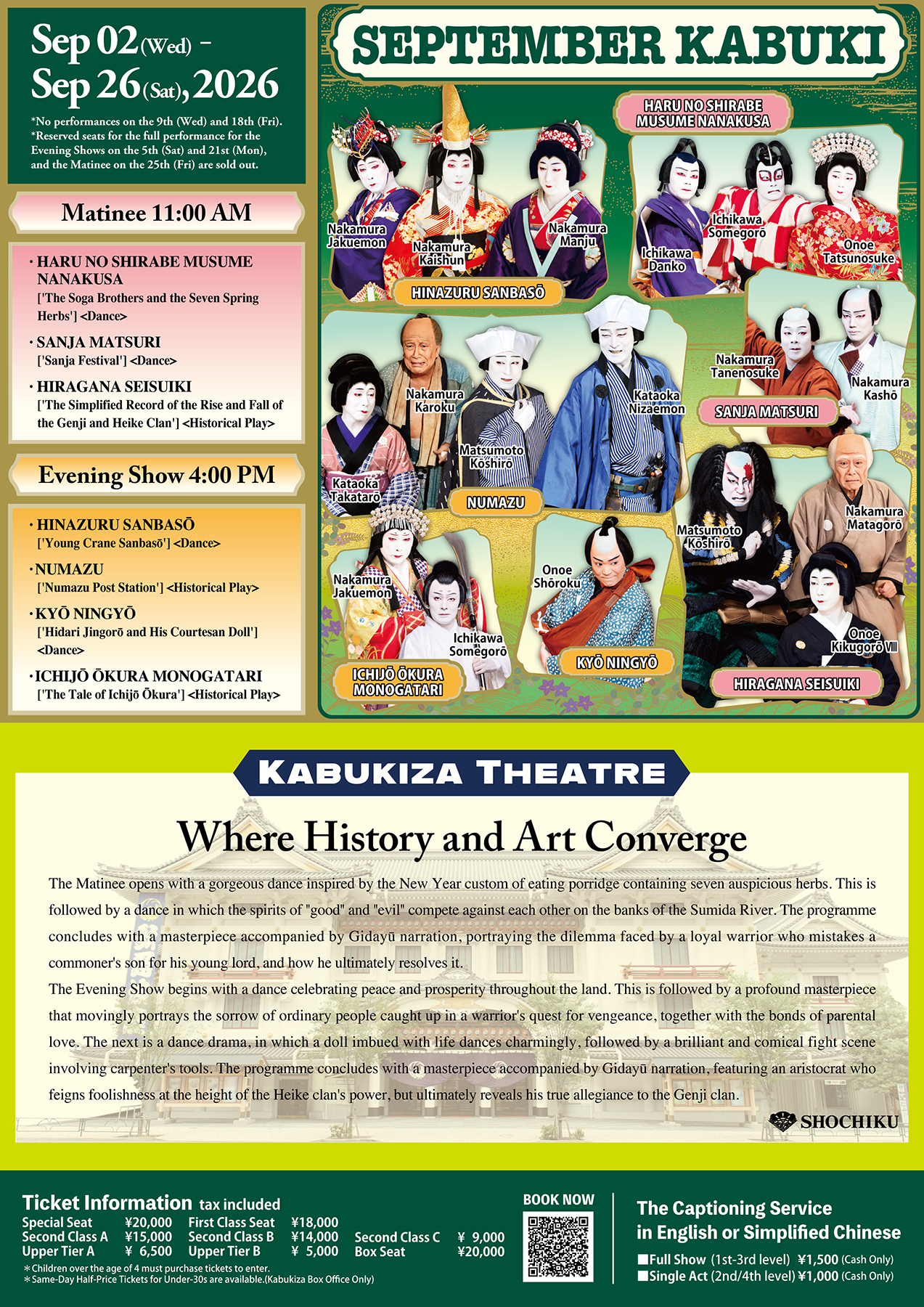
September Program at the Kabukiza Theatre
Daily: Sep 02 (Wed) - Sep 26 (Sat), 2026
Matinee:11:00 AM
Evening Show: 4:00 PM
*No performances on the 9th (Wed) and 18th (Fri).
*Reserved seats for the full performance for the Evening Shows on the 5th (Sat) and 21st (Mon), and the Matinee on the 25th (Fri) are sold out.
On sale: from Aug 14 (Fri), 2026 10:00 AM(JST)
Ticket Price
Special Seat: 20,000
First Class Seat: 18,000
Second Class A: 15,000
Second Class B: 14,000
Second Class C: 9,000
Upper Tier A: 6,500
Upper Tier B: 5,000
Box Seat: 20,000
Unit: Japanese Yen (tax included)
Ticket with "Captioning Service" (either English or simplified Chinese subtitles)
Tickets that include a captioning device are available on the website. Please select "Ticket with Captioning Service" (1,500 yen will be added to the ticket price) on the ticket purchase page.
*Special Seat and Box Seat: Not available online. Click here for details.
Kabukiza Theatre (at TOKYO) Theatre Information
- Single Act Tickets
- 【🔗How to buy tickets】Tickets may still be available from the promoter, Shochiku Co., Ltd. for dates that are shown as "sold out" online. To check availability and other preferred seating areas, please call +81(0)3 6745-0888 or visit the box office.
*Captioning service (either English or simplified Chinese subtitles) available to rent. Click here for details.
*Sold program (Detailed English synopsis are found at the end of the Japanese program) available.
The Matinee opens with a gorgeous dance inspired by the New Year custom of eating porridge containing seven auspicious herbs. This is followed by a dance in which the spirits of 'good' and 'evil' compete against each other on the banks of the Sumida River. The programme concludes with a masterpiece accompanied by Gidayū narration, portraying the dilemma faced by a loyal warrior who mistakes a commoner’s son for his young lord, and how he ultimately resolves it.
The Evening Show begins with a dance celebrating peace and prosperity throughout the land. This is followed by a profound masterpiece that movingly portrays the sorrow of ordinary people caught up in a warrior’s quest for vengeance, together with the bonds of parental love. The next is a dance drama, in which a doll imbued with life dances charmingly, followed by a brilliant and comical fight scene involving carpenter’s tools. The programme concludes with a masterpiece accompanied by Gidayū narration, featuring an aristocrat who feigns foolishness at the height of the Heike clan’s power, but ultimately reveals his true allegiance to the Genji clan.
 Kabukiza Theatre Stage Photo
HARU NO SHIRABE MUSUME NANAKUSA
SANJA MATSURI
['The Soga Brothers and the Seven Spring Herbs' and 'Sanja Festival']
CAST :
- <HARU NO SHIRABE MUSUME NANAKUSA>
Soga no Gorō
Ichikawa Somegorō- Soga no Jūrō
- Ichikawa Danko
- Shizuka Gozen
- Onoe Tatsunosuke
- <SANJA MATSURI>
The spirit of 'evil'
Nakamura Kashō- The spirit of 'good'
- Nakamura Tanenosuke
STORY :
Every New Year in the Edo period, plays were staged about the medieval vendetta carried out by the Soga brothers Jūrō and Gorō. This colorful, old-fashioned dance mixes this tradition with the custom of eating porridge containing seven auspicious herbs on the seventh day of the New Year. As the brothers Jūrō and Gorō prepare to face their father's murderer and take revenge, they cut the herbs together with beautiful Shizuka Gozen, as a symbolic act of vengeance.
The stage shifts to the Sumida River. Two fishermen are casting nets in the Sumida River. This illustrates the legend of the origins of the Asakusa Shrine, where two brothers fished a statue of the Buddhist deity Kannon out of the water. As the two perform a light-hearted dance, a cloud suddenly appears and they lose consciousness. When they wake up again, they are each possessed by the spirit of 'good' and the spirit of 'evil'. They start to dance again...
Intermission: 20 minutes
HIRAGANA SEISUIKI
Ōtsu Yadoya
Sasabiki
Sakaro
['The Inn at Ōtsu', 'Bamboo Cutting' and 'Reverse Rowing' from 'The Simplified Record of the Rise and Fall of the Genji and Heike Clans']
CAST :
- Matsuemon, a boatman, in reality, Higuchi Jirō Kanemitsu
- Matsumoto Kōshirō
- Hatakeyama Shigetada
- Onoe Shōroku
- Ofude
- Onoe Kikugorō VIII
- Myōjinmaru Tomizō, a boatman
- Ichikawa Somegorō
- Nadakichi Kurosaku, a boatman
- Onoe Tatsunosuke
- Hiyoshimaru Mataroku, a boatman
- Ichikawa Danko
- Matsuemon in distant view
- Nakamura Tanetarō
- Komawakamaru
- Nakamura Hidenosuke
- A retainer of Hatakeyama
- Sawamura Sōnosuke
- A retainer of Hatakeyama
- Otani Hirotarō
- A retainer of Hatakeyama
- Ichikawa Otora
- A retainer of Hatakeyama
- Nakamura Kichinojō
- Unnen, a priest
- Matsumoto Kingo
- Gonshirō, a boatman
- Nakamura Matagorō
- Oyoshi
- Nakamura Jakuemon
STORY :
After the death of Kiso Yoshinaka, his widow Lady Yamabuki and their young son Komawakamaru wander from province to province, fleeing the Kamakura forces with the help of their loyal retainer Kamata Hayato and Lady Yamabuki's maid-in-waiting Ofude. At last they arrive at an inn in Ōtsu, where the boatman Gonshirō and his daughter Oyoshi are also staying. Before long, however, the Kamakura warrior Banba no Chūta tracks them down…
Meanwhile, another tragic drama unfolds for the survivors of the Yoshinaka faction. Matsuemon, who has married into the family of the country boatman Gonshirō, is actually the warrior Higuchi Kanemitsu in disguise—a leading retainer of Yoshinaka. Having learned special rowing skills, he is invited to transport the Genji general Yoshitsune, whose forces were responsible for Yoshinaka's death. Matsuemon sees this as the ultimate opportunity to take his revenge. However, before he can put his plan into action, his identity is discovered, leading to a spectacular battle on sea and land that seals his fate.
HINAZURU SANBASŌ
['Young Crane Sanbasō']
CAST :
- Okina
- Nakamura Kaishun
- Senzai
- Nakamura Jakuemon
- Sanbasō
- Nakamura Manju
STORY :
Okina appears accompanied by Senzai and performs a stately, dignified dance praying for peace and prosperity throughout the land. He is joined by Sanbasō, who offers prayers for a bountiful harvest in a vigorous and energetic dance. This work adapts the ceremonial dance Sanbasō, traditionally performed as a prayer for peace, for onnagata (male specialists in female roles). Performed by Kaishun, Manju and Jakuemon, it is an elegant and refined dance that showcases the grace and artistry of these distinguished performers.
Intermission: 20 minutes
Igagoe Dōchū Sugoroku
NUMAZU
['Numazu Post Station' from 'The Vendetta at Iga Province']
CAST :
- Jūbē, a draper
- Kataoka Nizaemon (Program A)
- Matsumoto Kōshirō (Program B)
- Oyone, Heisaku’s daughter
- Kataoka Takatarō
- Yasubē, a porter
- Kataoka Matsunosuke (Program A)
- Nakamura Kichinojō (Program B)
- Ikezoe Magohachi
- Nakamura Hayato
- Heisaku, a porter
- Nakamura Karoku
※Program B (9/4・5・6・10・11・14・15・19・20・23・24)
STORY :
This play is a dramatization of one of the most famous historical vendettas of the Edo period. This act shows the tragedy of the common people who unintentionally got involved in the vendetta. The kimono merchant Jūbē meets the porter Heisaku as he travels west on business. Heisaku tries to carry Jūbē's luggage, but he is unsteady on his feet and finally gets hurt. As Heisaku's daughter Oyone passes by, Jūbē falls in love with her at first sight and stops at Heisaku's house. During his stay there, Oyone attempts to steal Jūbē's inrō (medicine case) for her husband. They finally find out that, not only are they long-separated family relations, but that their loyalties also lie on opposite sides of the vendetta. Their loyalties prevent them from openly acknowledging their relationship, so Heisaku sacrifices his life to get information from his son, and…
Intermission: 35 minutes
KYŌ NINGYŌ
['Hidari Jingorō and His Courtesan Doll']
CAST :
- Hidari Jingorō
- Onoe Shōroku
- Spirit of the Doll
- Nakamura Tokizō
- Omitsu, in reality Lady Izutsu
- Onoe Tatsunosuke
- Kuriyama Daizō
- Nakamura Kichinojō
- Otoku, Jingorō’s wife
- Bandō Shingo
- Teruhei, a footman
- Bandō Kamezō
STORY :
This dance tells the story of Hidari Jingorō, a wood sculptor famous for carving the sleeping cat on the great gate of Nikkō Shrine. Falling in love with a beautiful courtesan, he carves a doll that looks exactly like her. The doll suddenly starts moving, as though it were alive, and Jingorō enjoys his time with the sculpture. At the end of the dance, there is a spectacular fight scene in which Jingorō is set upon by carpenters brandishing their tools.
Intermission: 20 minutes
ICHIJŌ ŌKURA MONOGATARI
Okuden
['The Tale of Ichijō Ōkura']
CAST :
- Ichijō Ōkura Naganari, a lord
- Ichikawa Somegorō
- Yoshioka Kijirō
- Nakamura Kashō
- Okyō, Kijirō’s wife
- Nakamura Tanenosuke
- Naruse, Kageyu’s wife
- Ichikawa Komazō
- Yatsurugi Kageyu
- Matsumoto Kōshirō
- Lady Tokiwa, Naganari’s wife
- Nakamura Jakuemon
STORY :
This is a 'jidaimono' history play set in the 12th century. The Genji retainer Kijirō and his wife Okyō believed that Lady Tokiwa, the widow of the Genji leader Yoshitomo, had given up on her clan's struggle against the enemy Heike, but they rejoice to find that she secretly prays for the Heike's downfall. Yatsurugi Kageyu, one of the retainers of her current husband, the aristocrat Ōkura, discovers this. When he declares that he will tell Kiyomori about Lady Tokiwa's secret, he is killed by Ōkura. Though Ōkura seems to be nothing more than a fool, this is actually an elaborate disguise to hide his loyalty to the Genji clan and to survive in this turbulent world.