

 Kabukiza Theatre
Kabukiza Theatre
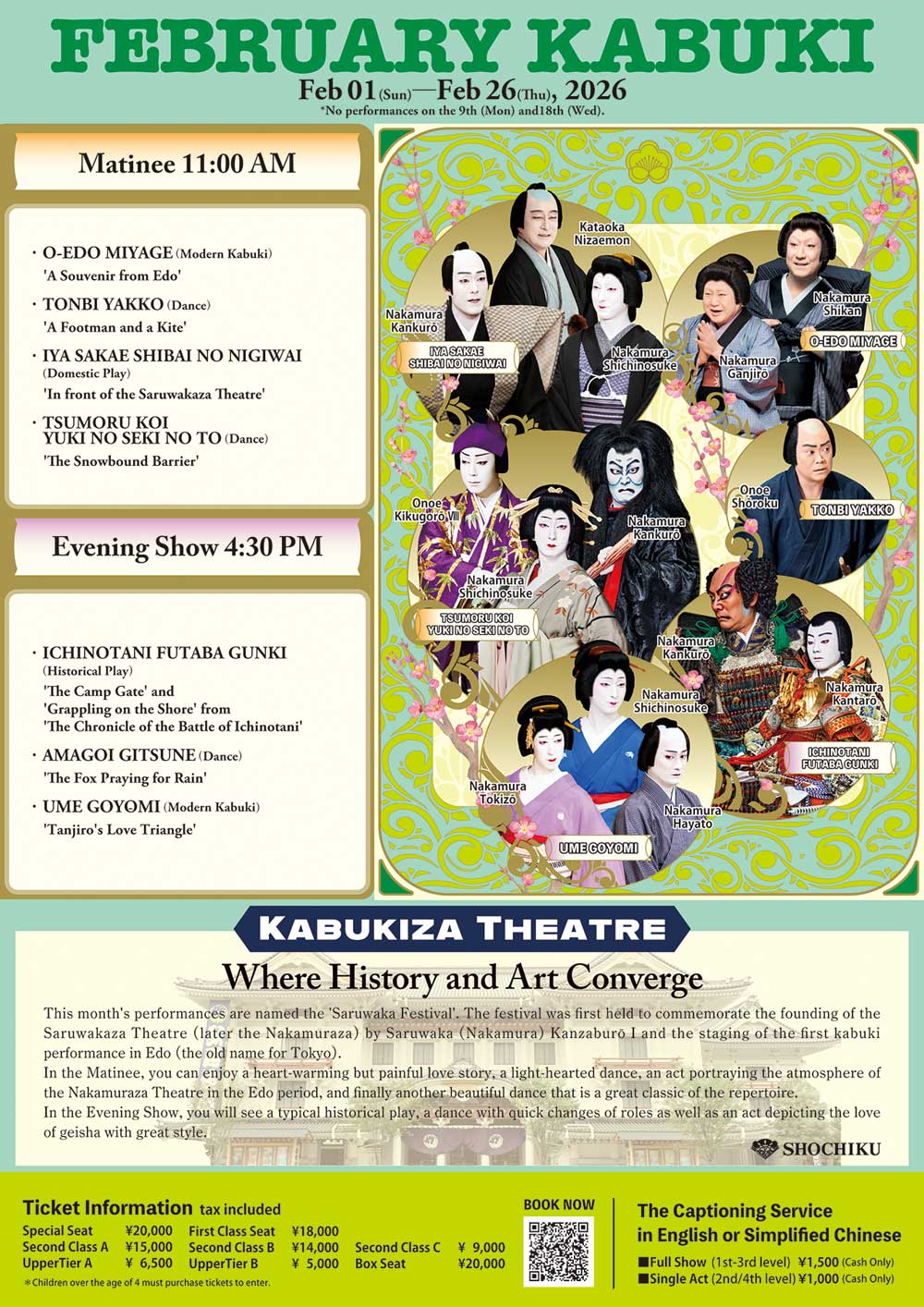
February Program at the Kabukiza Theatre
Daily: Feb 01 (Sun) - Feb 26 (Thu), 2026
Matinee:11:00 AM
Evening Show: 4:30 PM
*No performances on the 9th (Mon) and18th (Wed).
On sale: from Jan 14 (Wed), 2026 10:00 AM(JST)
Ticket Price
Special Seat: 20,000
First Class Seat: 18,000
Second Class A: 15,000
Second Class B: 14,000
Second Class C: 9,000
Upper Tier A: 6,500
Upper Tier B: 5,000
Box Seat: 20,000
Unit: Japanese Yen (tax included)
Ticket with "Captioning Service" (either English or simplified Chinese subtitles)
Tickets that include a captioning device are available on the website. Please select "Ticket with Captioning Service" (1,500 yen will be added to the ticket price) on the ticket purchase page.
*Special Seat and Box Seat: Not available online. Click here for details.
Kabukiza Theatre (at TOKYO) Theatre Information
- Single Act Tickets
- 【🔗How to buy tickets】Tickets may still be available from the promoter, Shochiku Co., Ltd. for dates that are shown as "sold out" online. To check availability and other preferred seating areas, please call +81(0)3 6745-0888 or visit the box office. To check availability and other preferred seating areas, please call +81(0)3 6745-0888 or visit the box office.
*Captioning service (either English or simplified Chinese subtitles) available to rent. Click here for details.
*Sold program (Detailed English synopsis are found at the end of the Japanese program) available.
This month's performances are named the 'Saruwaka Festival'. The festival was first held to commemorate the founding of the Saruwakaza Theatre (later the Nakamuraza) by Saruwaka (Nakamura) Kanzaburō I and the staging of the first kabuki performance in Edo (the old name for Tokyo).
In the Matinee, you can enjoy a heart-warming but painful love story, a light-hearted dance, an act portraying the atmosphere of the Nakamuraza Theatre in the Edo period, and finally another beautiful dance that is a great classic of the repertoire.
In the Evening Show, you will see a typical historical play, a dance with quick changes of roles as well as an act depicting the love of geisha with great style.
 Kabukiza Theatre Stage Photo
O-EDO MIYAGE
['A Souvenir from Edo']
CAST :
- Otsuji
- Nakamura Ganjirō
- Bandō Eishi
- Bandō Minosuke
- Okon
- Nakamura Tanenosuke
- Kakubē, the elder lion dancer
- Nakamura Utanosuke
- Rokusaburō, the head of a firefighting brigade
- Bandō Kamezō
- Tokiwazu Mojitatsu
- Kataoka Takatarō
- Oyū
- Nakamura Shikan
STORY :
This 'New Kabuki' play is a light-hearted comedy portraying a fanciful episode from the life of commoners in the Edo period. Two women who travel annually to Edo to sell the cloth that they weave encounter a young couple. Moved by the spirit of romance, Otsuji spends all the money that she has made for a once-in-a-lifetime meeting with a fabulously handsome kabuki actor...
Intermission: 15 minutes
TONBI YAKKO
['A Footman and a Kite']
CAST :
- A footman
- Onoe Shōroku
STORY :
A kite flies off with the first bonito of the season which a footman has bought for his master. The footman chases the kite with a pole from a well in his hand, intending to knock down the kite with it. Please enjoy this cheerful dance which portrays the lives of chic ordinary people in the Edo period.
Intermission: 35 minutes
IYA SAKAE SHIBAI NO NIGIWAI
Saruwakaza Shibai Mae
['In front of the Saruwakaza Theatre']
CAST :
- Manager of the Saruwakaza Theatre
- Nakamura Kankurō
- His wife
- Nakamura Shichinosuke
- A chivalrous townsman
- Nakamura Kashō
- A chivalrous townsman
- Nakamura Mantarō
- A chivalrous townsman
- Nakamura Hashinosuke
- A chivalrous townsman
- Nakamura Toranosuke
- A chivalrous townsman
- Nakamura Utanosuke
- A chivalrous townswoman
- Bandō Shingo
- A chivalrous townswoman
- Nakamura Tanenosuke
- A chivalrous townswoman
- Ichikawa Otora
- A chivalrous townswoman
- Nakamura Kangyoku
- A chivalrous townswoman
- Nakamura Tamatarō
- Azuma, Shinzaemon’s wife
- Kataoka Takatarō
- Kōkichi, Saruwaka town administrator
- Nakamura Shikan
- Ohiro, the proprietress of the theatre teahouse Ōgiya
- Nakamura Senjaku
- Oei, Kōkichi’s wife
- Nakamura Fukusuke
- Shinzaemon, master of the draper’s shop Matsushima
- Kataoka Nizaemon
STORY :
This play is what is called 'Shibai Mae'. The stage is made to resemble the area in front of the Nakamuraza Theatre in the Edo Period and the principal actors of the troupe gather here.
Intermission: 30 minutes
TSUMORU KOI YUKI NO SEKI NO TO
['The Snowbound Barrier']
CAST :
- Sekibē, the barrier guard, in reality Ōtomo no Kuronushi
- Nakamura Kankurō
- Lady Ono no Komachi/
Sumizome, a courtesan, in reality the spirit of the cherry tree -
Nakamura Shichinosuke - Yoshimine no Shōshō Munesada
- Onoe Kikugorō VIII
STORY :
One of the greatest dance dramas in the kabuki repertory, this work combines romance, drama and comedy set against a fantastic, legendary background. A snow-covered barrier with a mysterious cherry tree in full bloom provides the background of the legend about a traitorous aristocrat disguised as a barrier guard, and the beautiful woman who defeats him, actually the spirit of the cherry tree in human form.
ICHINOTANI FUTABA GUNKI
Jinmon
Kumiuchi
['The Camp Gate' and 'Grappling on the Shore' from 'The Chronicle of the Battle of Ichinotani']
CAST :
- Kumagai no Jirō Naozane
- Nakamura Kankurō
- Kumagai no Kojirō Naoie / Taira no Atsumori
- Nakamura Kantarō
- Lady Tamaori
- Bandō Shingo
STORY :
The young Genji warrior Kumagai no Kojirō Naoie attacks the enemy Heike Camp on Suma Beach. His father Naozane worries about him being in his first battle and takes him back to the Kumagai battle camp. Although they are enemies, Naozane must later spare the young Heike general Atsumori because he is the son of the Emperor. Naozane does so by making his own son a substitute.
In addition to seeing the gallant figures of Naoie and Atsumori, a unique staging technique is used to represent people in the distance by using children.
Intermission: 35 minutes
AMAGOI GITSUNE
['The Fox Praying for Rain']
CAST :
- A blind masseur
Ono no Tōfū
A fox
Nakamura Kankurō- A fox
A shrine maiden praying for rain
A fox bride
Nakamura Shichinosuke
STORY :
They say that when it rains while the sun is shining, it means that the bridal procession of a fox is passing. That is what is shown in this relatively modern dance starring a talented dancer as a magical fox that does a series of dances in five highly contrasting roles: a fox, a shrine maiden praying for rain, a blind masseur and the fox bride in a bridal procession.
Intermission: 25 minutes
7:29 PM - 7:38 PM
(Intermission: 5 minutes)
7:43 PM - 9:02 PM
UME GOYOMI
['Tanjirō's Love Triangle']
CAST :
- Adakichi, a geisha
- Nakamura Shichinosuke
- Yonehachi, a geisha
- Nakamura Tokizō
- Tanjirō
- Nakamura Hayato
- Chiba Hanjirō
- Nakamura Hashinosuke
- Ochō, Tanjirō’s fiancée
- Nakamura Kangyoku
- Furutori Sabunta
- Nakamura Kikaku
- Honda Jirō Chikatsune
- Nakamura Matsue
- Chiba Tōbē
- Nakamura Matagorō
STORY :
This work is a kabuki adaptation of a famous love story from the Edo Period called 'Shunshoku Ume Goyomi'.
Tanjirō, the foster child of a rich merchant in the Yoshiwara pleasure quarters lives with Yonehachi, a geisha of the Fukagawa district, even though he has a fiancée named Ochō. Adakichi, another geisha in Fukagawa, falls in love with him at first sight as they pass each other on boats, and she and Yonehachi become rivals for Tanjirō's love.
Tanjirō's master Chiba Hanjirō was disowned for losing a precious tea caddy named 'Zangetsu', the heirloom of the Hatakeyama clan, and he now lives at Tanjirō's house. Adakichi persuades Furutori Sabunta to sell the tea caddy in his possession as she wants to get it for Tanjirō who is searching for the lost one with Hanjirō. But this tea caddy turns out to be a complete fake. Tanjirō recovers the genuine one after great difficulty and hands it to Hanjirō. As a result, Hanjirō is permitted to return to his house and the ill feeling between Adakichi and Yonehachi dispels and they make up.