

 Other Theatres
Other Theatres
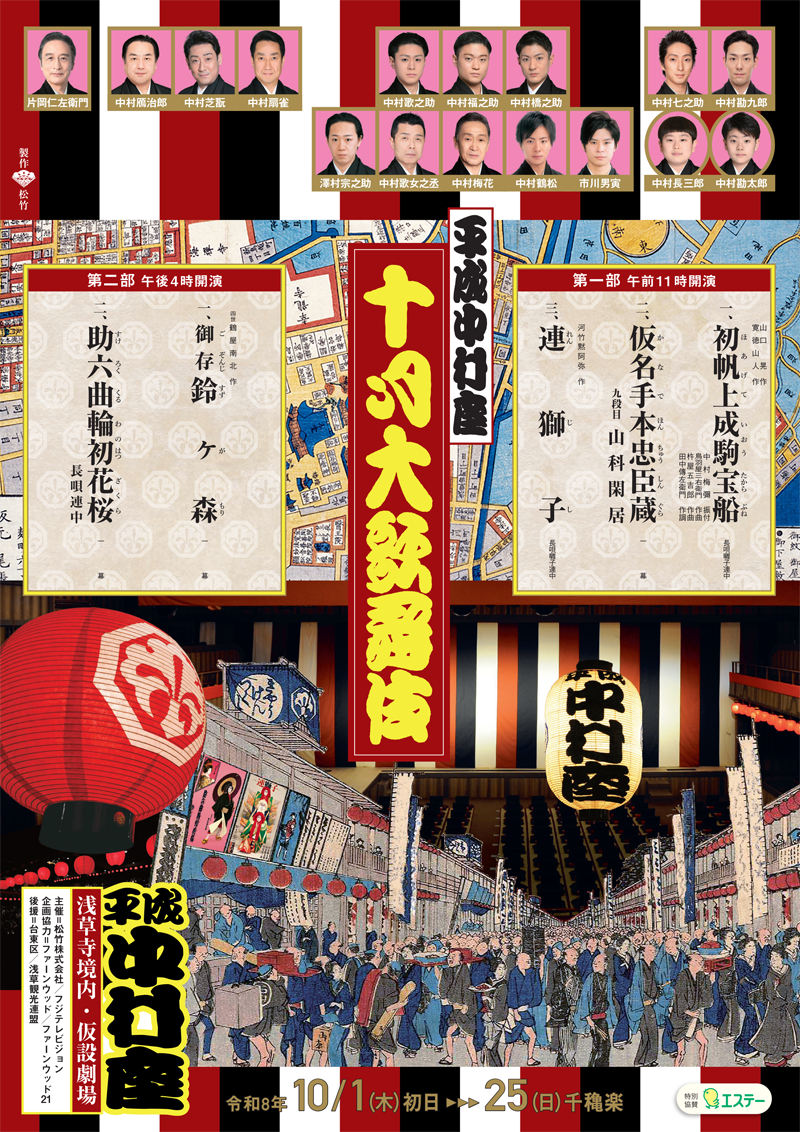
October Program at the Heisei Nakamuraza Theatre
Daily: Oct 01 (Thu) - Oct 25 (Sun), 2026
Part 1:11:00 AM
Part 2: 4:00 PM
[Important Notice]
●Notification of the cancellation of October 21st performances (Oct 21)
◇Schedule
◇Seating Chart
On sale: from Aug 07 (Fri), 2026 10:00 AM(JST)
MATSU Seat (Level 1): 16,500
TAKE Seat (Level 1, Level 2): 16,500
UME Seat (Level 2): 13,000
SAKURA Seat (Level 2): 11,000
ODAIJIN Seat (Level 2): 36,000
Unit: Japanese Yen (tax included)
*Children over the age of 4 must purchase tickets to enter.
*ODAIJIN Seats, MATSU Seats and SAKURA Seats are not available for online purchase. Click here for details.
*In the MATSU seats you will be seated on the floor on zabuton cushions. Special chairs are provided in the ODAIJIN Seats, while all other seating consists of benches.
*Outdoor shoes are not permitted inside the theatre. Please take off your shoes at the entrance.
*Customers with tickets for consecutive sessions are asked to leave the theatre once the previous session has ended.
Access to the theatre (Temporary theatre in the Sensō-ji Temple)
- 【🔗How to buy tickets】Tickets may still be available from the promoter, Shochiku Co., Ltd. for dates that are shown as "sold out" online. To check availability and other preferred seating areas, please call +81(0)3 6745-0888 or visit the box office.
*No English supporting guide available.
*Sold program (Detailed English synopsis are found at the end of the Japanese program) available.
Edo kabuki is said to have originated in 1624, when the first Saruwaka (later Nakamura) Kanzaburō built the Saruwakaza (later known as the Nakamuraza Theatre) in Edo—the first theatre officially recognized by the shogunate. Beloved by the common people, the Nakamuraza Theatre flourished as the leading theatre among the Three Great Theatres of Edo. Fast forward to 2000. Inspired by the passionate vision of the eighteenth Nakamura Kanzaburō, who had taken the kabuki world by storm, the 'Heisei Nakamuraza Theatre' was established in Asakusa to revive for the modern era the vibrant spirit of the Nakamuraza Theatre that once captivated the common people of Edo.
This temporary theatre, a recreation of an Edo-period playhouse, has captivated audiences worldwide since its opening not only in Asakusa and throughout Japan, but also in New York and across Europe.
 Heisei Nakamuraza Theatre Stage Photo
HO AGETE IOU TAKARABUNE
['Celebrating a new Start of the Actors']
CAST :
- Hashihiko
- Nakamura Hashinosuke
- Fukuhiko
- Nakamura Fukunosuke
- Utahiko
- Nakamura Utanosuke
STORY :
This dance was created in 2016 to celebrate the name-taking ceremony of the three sons of Nakamura Shikan VIII: Nakamura Kunio, who became Nakamura Hashinosuke IV; Nakamura Muneo, who became Nakamura Fukunosuke III; and Nakamura Yoshio, who became Nakamura Utanosuke IV. It will now be performed for the first time since its premiere. A lively and celebratory dance performed by the three brothers.
Intermission: 30 minutes
KANADEHON CHŪSHINGURA
- Act 9: Yamashina Kankyo
['The Treasury of Loyal Retainers Yuranosuke at Yamashina']
CAST :
- Tonase
- Nakamura Shichinosuke
- Ōboshi Yuranosuke
- Nakamura Kankurō
- Oishi
- Nakamura Senjaku
- Kakogawa Honzō
- Nakamura Ganjirō
STORY :
This is Act 9 of the epic play based on a sensational incident in the early eighteenth century. Lord En’ya Hangan's attack on the senior official Kō no Moronō affected people even outside his own household. When Honzō, the senior retainer of another lord, stopped En’ya from killing Moronō, he thought that he was doing a good thing. But his actions earned him the scorn of En’ya's retainers and brought personal tragedy to his daughter who was engaged to Rikiya, the son of Yuranosuke, En’ya's head retainer. The scene is set in snowbound Yamashina near Kyoto where Yuranosuke has seemingly retired. It shows the tragedy as it affects Honzō's wife and daughter and how ultimately Honzō sacrifices his life to atone for his misjudgment.
Intermission: 30 minutes
RENJISHI
['Parent and Child Lion Dance']
CAST :
- The actor Ukon, later, the spirit of the parent lion
- Nakamura Kankurō
- The actor Sakon, later, the spirit of the lion cub
- Nakamura Kantarō
- The actor Sakon, later, the spirit of the lion cub
- Nakamura Chōzaburō
STORY :
This is a dance adapted from a tale featuring the legendary 'shishi', a mythical lion-like beast. It is based on the belief that a 'shishi' will push its cubs over a steep cliff as a test of their strength, only nurturing those cubs strong enough to climb up by themselves. Two priests dance the tale of the legendary 'shishi' that live at the foot of a holy Buddhist mountain. The dance portrays a parent 'shishi' forcing its cubs to undergo harsh training in order to grow up strong. In the finale, the 'shishi' themselves appear and perform their dance with the wild shaking of their long manes.
GOZONJI SUZUGAMORI
['Gonpachi and Banzui'in Chōbē']
CAST :
- Banzui'in Chōbē
- Nakamura Shikan
- Shirai Gonpachi
- Nakamura Kantarō
STORY :
This is a short scene from Tsuruya Nanboku's play 'Ukiyozuka Hiyoku no Inazuma'. The young samurai Gonpachi is ambushed near the execution grounds of Edo on a dark night, but he manages to escape after a gruesome but humorous fight scene. Watching from a nearby palanquin, Chōbē, a chivalrous townsman, is impressed with Gonpachi's fighting skills and agrees to give him shelter in the city. This meeting between the handsome young Gonpachi and the heroic Chōbē is one of the most famous meetings in kabuki.
Intermission: 30 minutes
(Intermission: 10 minutes)
7:15 PM - 7:25 PM
SUKEROKU KURUWA NO HATSU ZAKURA
['Sukeroku in the Pleasure Quarters']
CAST :
- Hanakawado no Sukeroku
- Nakamura Kankurō
- Agemaki, a great courtesan of the Miuraya
- Nakamura Shichinosuke
- Hige no Ikyū
- Nakamura Shikan
- Soga no Mankō, Sukeroku’s mother
- Nakamura Kamenojō (from 1st to 22th)
- Nakamura Senjaku (from 23rd to 25th)
- Rigyō, a man-about-town
- Nakamura Ganjirō
- Shinbē, Sukeroku’s elder brother
- Nakamura Senjaku (from 1st to 22th)
- Kataoka Nizaemon (from 23rd to 25th)
STORY :
The Yoshiwara Pleasure quarters in Edo (old Tokyo) are bustling as always. Wearing the most gorgeous kimono, Agemaki, the top courtesan of the Miuraya teahouse, is tipsy and rests in front of the shop. Ikyū, the bearded gallant is in love with her and speaks ill of her lover Sukeroku out of jealousy. Hearing these words, she becomes furious and picks a fight. Just then, Sukeroku himself appears, and after showing off his handsome appearance, he tries to start a fight with Ikyū. This is not a surprise, for Sukeroku is famous for starting fights with people, but this is actually Sukeroku's plan to unsheathe people's swords in order to find out who stole the treasured sword that led to his father's death. Sukeroku finally sees that Ikyū has this very sword and ambushes him ....